Most Frenchie owners are told that "doggy breath" is normal. It isn't. That smell is anaerobic bacteria, actively eating gum tissue. And in a Frenchie's crowded little mouth, the disease moves faster than almost any other breed.
I. What Dental Crowding Is
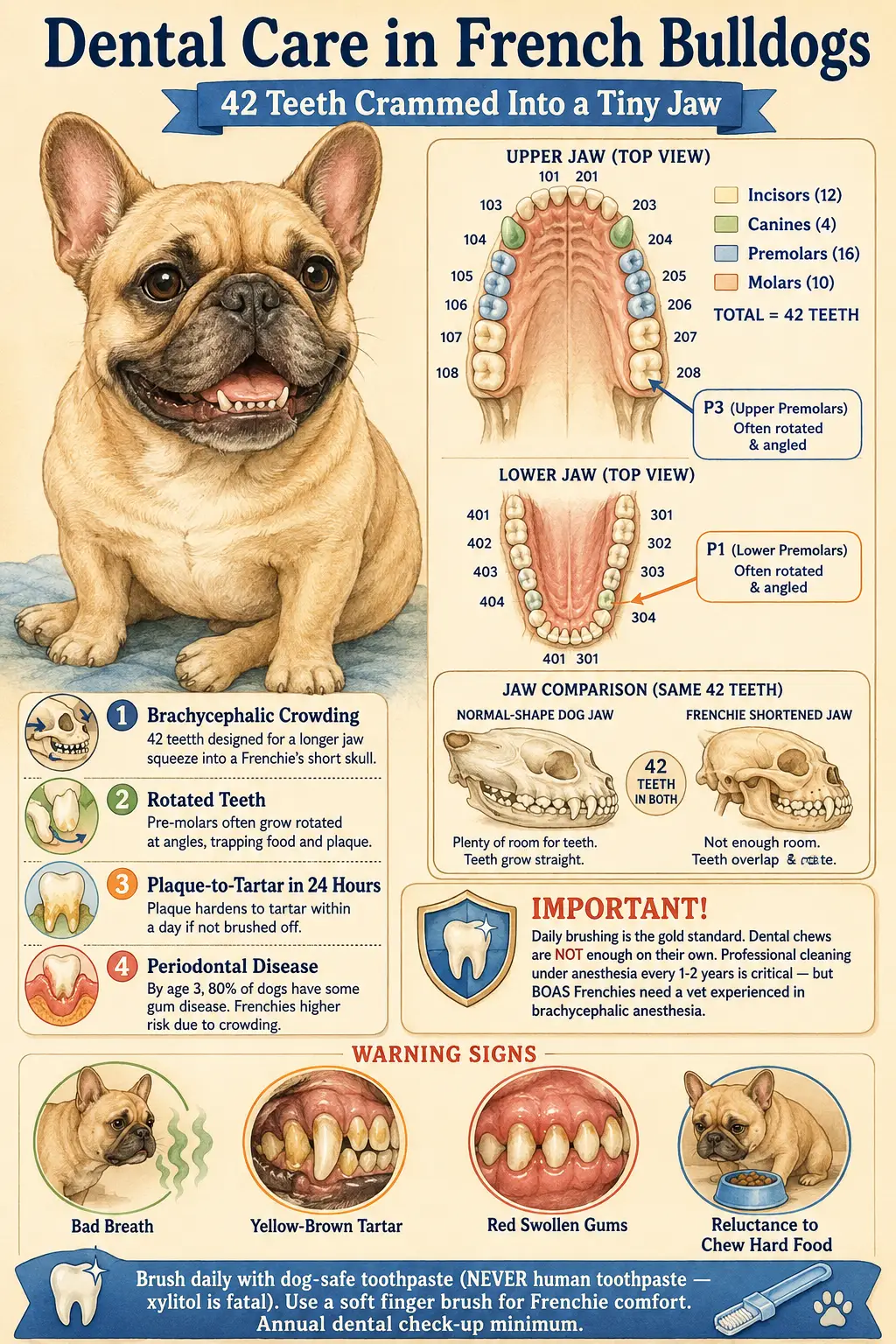
Dogs have 42 adult teeth. The Frenchie brachycephalic jaw is shortened, but tooth count isn't. Teeth are pushed sideways, rotated, and stacked. Food packs into gaps. Plaque calcifies into tartar in 24–48 hours. Tartar sits below the gumline, producing chronic gum inflammation — periodontal disease, with bone loss, gum recession, and eventual tooth loss.
II. The Underdiagnosis Paradox
VetCompass 2021 found lower diagnosed periodontal disease in Frenchies (1.6%) vs non-Frenchies (12.8%) — adjusted OR 0.31. Almost certainly underdiagnosis, not protection. Frenchies present for breathing, skin, ear, and orthopedic issues — mouths often go unexamined unless they reek.
Veterinary dentistry literature consistently flags brachycephalic dogs as HIGH-RISK for periodontal disease and dental crowding.
Half of dental pathology is below the gumline. The other half is being ignored as 'normal Frenchie breath.'
III. Why Frenchies Are Prone
- Crowding & rotation — upper P3 and lower P1 most commonly rotated. Rotated teeth = abnormal periodontal pockets that trap food.
- Mandibular first premolar cyst risk — missing or unerupted P1 in brachycephalic dogs predisposes to dentigerous cyst formation. AVDC: any missing P1 in a Frenchie should be radiographed.
- Reduced mandibular bone density with age — extractions needed earlier.
- Mouth breathing (BOAS dogs) — chronic open-mouth breathing dries oral mucosa and accelerates plaque.
IV. Symptoms Owners Miss
- Bad breath — actively foul, sulfuric (NOT just "doggy breath").
- Brown or yellow buildup at the gumline.
- Red or swollen gums.
- Gum recession (teeth look "longer").
- Bleeding when chewing.
- Dropping food.
- Chewing on one side.
- Loose teeth.
- Facial swelling under the eye = often P4 abscess.
V. Why It Matters Beyond the Mouth
Veterinary literature shows dogs with severe (stage 3) periodontal disease have a significantly elevated risk of endocarditis (heart valve infection). Published hazard ratios in this range have been reported, exact figures vary by study.
Oral bacteria entering the bloodstream during chewing reach kidney and liver capillaries → microabscesses. Documented links: azotemic chronic kidney disease, cardiac disease, hepatic disease, thromboembolic events.
In small or brachycephalic breeds with thinning mandibles: severe periodontal bone loss can cause spontaneous mandibular fracture from normal chewing.

"Brushing isn't optional in this breed. Spike gets brushed 3–4 times a week with a soft pet brush and dog paste — never human paste, the xylitol is fatal. The mouth is small, the teeth are crowded, and bacteria don't take days off."
VI. Daily Home Care
Brushing
- YES, Frenchies can be brushed.
- Daily = gold standard (plaque mineralizes in 24 hours).
- 2–3× per week = realistic minimum that moves the needle.
- Soft pet toothbrush or finger brush.
- Dog toothpaste only — xylitol in human paste = liver failure / hypoglycemia.
- Focus on outer surfaces along the gumline.
VOHC-Accepted Products
VOHC = the only seal backed by clinical plaque/tartar reduction data ≥20%.
- Greenies, OraVet Dental Hygiene Chews, Whimzees, Virbac C.E.T. VeggieDent.
- AVOID products that "claim vet recommended" without VOHC seal — VOHC is third-party reviewed.
Water Additives
VOHC accepts a few (Healthymouth, OraVet) — they help but don't replace brushing.
VII. Professional Cleaning Under Anesthesia
- Small breeds and brachycephalics often need COHAT every 6–12 months.
- AAHA: first cleaning by age 1 for small breeds.
- Cost: $350–500 routine GP, $800–1,500+ if extractions, $1,500+ for specialist dentistry.
Condemned by AVDC and AAHA. They only scrape visible crowns (cosmetic), miss subgingival plaque (real disease), and can't get full-mouth dental radiographs (which catch ~60% of pathology that's invisible above the gumline). Modern anesthesia is far safer than untreated periodontal sepsis.
VIII. Tooth Extraction in Frenchies
Most commonly extracted: rotated upper P3, lower P1, severely crowded incisors, fractured upper P4 (slab fractures from chewing hard items).
After clearance, Frenchies often eat better — they had been chewing around painful teeth.
IX. Common Owner Mistakes
- Ignoring "doggy breath" — that's anaerobic bacteria, active disease. NEVER normal.
- Grain-free dental chew myth — grain content has no clinical relevance to dental efficacy. Look for VOHC.
- Bones, antlers, hard nylon toys — leading cause of slab fractures. AVDC rule: if you can't dent it with a fingernail, it's too hard.
- Skipping the annual oral exam — half of dental pathology is below the gumline.
- Avoiding anesthesia — modern anesthesia is far safer than untreated periodontal sepsis.
References
- VetCompass Frenchies study. PMC8675495
- Periodontal disease in UK primary care. PMC9291557
- Periodontal & systemic diseases in dogs. PubMed 31226571
- VOHC Accepted Products List. VOHC.org
- North Bay Veterinary Dentistry — Brachycephalic dental. NorthBayVetDentist.com
- Dvm360 — Small teeth, big challenges. Dvm360.com