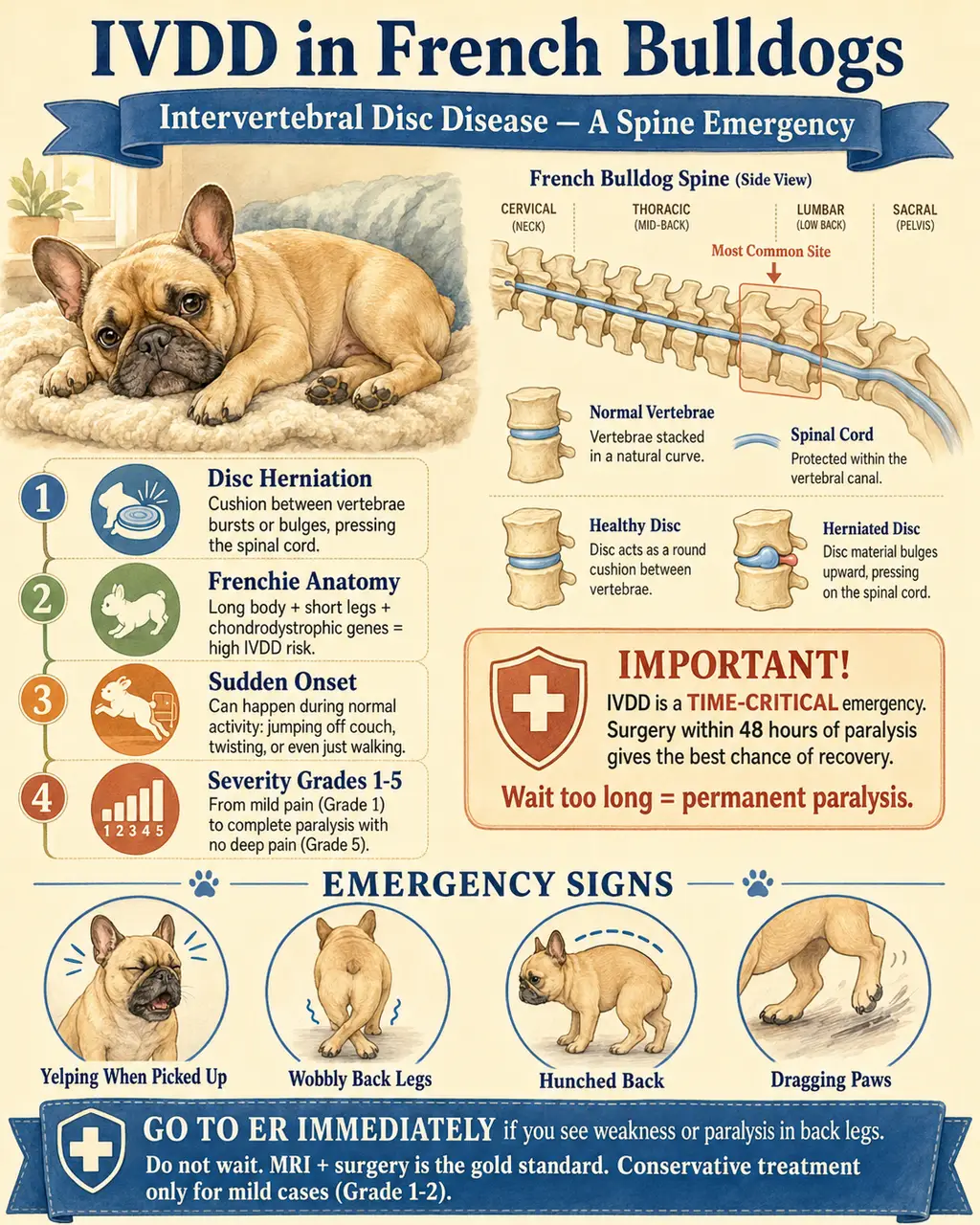
"Fine this morning, paralyzed by lunch." That's the IVDD story almost every Frenchie owner who has lived through it tells. The breed's genetic gift — the short legs, the long body, the comic squat — comes with a curse. Discs that calcify before the dog turns two, then explode without warning.
I. ER — Right Now
Sudden inability to walk or use back legs. Crying out when picked up or moved. Hunched, tense back posture. Dragging feet, knuckling over. Loss of bladder or bowel control. No response when toes are pinched (Grade 5).
Time matters most for Grade 5. Every hour past 48 reduces recovery odds.
II. What IVDD Actually Is
A spinal condition where the cushioning disc between vertebrae bulges, ruptures, or extrudes upward into the spinal canal. Disc material presses on the spinal cord, producing pain, weakness, or paralysis.
Think of a jelly donut between two bones. The jelly squirts out, hits the spinal cord, and the dog can't tell their legs to move.
III. Why Frenchies Are Prone
Frenchies are chondrodystrophic — their cartilage develops abnormally because of an FGF4 retrogene insertion on chromosome 12. Discs calcify and dehydrate at 1–2 years of age: brittle, dry, and prone to sudden explosive rupture (vs. the slow degeneration in non-chondrodystrophic breeds).
The short legs and elongated back that make Frenchies look like Frenchies come from the same genetic mutation that destroys their discs.
The numbers (Dog Aging Project 2025, JAVMA, n=43,517)
- French Bulldogs: 8.4% lifetime prevalence — second only to Dachshunds.
- Adjusted OR 21.1 vs. mixed-breed (95% CI 12.5–35.8).
- Median diagnosis age: 4.6 years (range 2.6–6.8) — significantly younger than other high-risk breeds.
IV. Hansen Type I — The Bulldog Type
Frenchies almost exclusively get Hansen Type I extrusions — acute, explosive disc ruptures. The inner nucleus pulposus violently herniates through the outer annulus. This is the classic "fine this morning, paralyzed by lunch" presentation.
Most herniations occur in the thoracolumbar region (T11–L2) — the transition between the rib cage and the lower back.
He jumped off the couch like he had a thousand times. By dinner he couldn't move his back legs. We made the 48-hour window by an hour.
V. Symptoms by Grade
| Grade | Description |
|---|---|
| Grade 1 | Pain only — yelping when picked up, hunched back, reluctance to move, trembling. |
| Grade 2 | Weakness — wobbly hind end (ataxia), still walking but uncoordinated. |
| Grade 3 | Cannot walk but feels pain — non-ambulatory paraparesis, can move legs but not stand. |
| Grade 4 | Paralysis with deep pain present — paralyzed, but pinching toes triggers a conscious reaction. |
| Grade 5 | Paralysis + NO deep pain — EMERGENCY. Toe pinch produces no conscious response. |
How it gets diagnosed
- MRI — the gold standard ($1,500–$3,500).
- CT myelogram — alternative when MRI isn't available.
VI. Treatment — Conservative or Surgical
Conservative (Grades 1–2)
- 4–6 weeks of strict crate rest.
- NSAIDs, gabapentin, muscle relaxers (vet-prescribed).
- Anti-inflammatories.
Surgical (Grades 3–5)
- Hemilaminectomy — the surgeon removes a window of vertebral bone and scoops out herniated disc material.
Recovery rates by grade
- Grade 3–4: ~93% recovery.
- Grade 5: ~61% with surgery vs. 10% conservative.
VII. The 48-Hour Rule
For Grade 5 (no deep pain), surgery within 24–48 hours = ~50–60% recovery. After 48 hours, prognosis collapses dramatically.
If you can pinch the toes and the dog has no conscious response, you are on the clock. Drive to the closest emergency neurology service. Don't try conservative care first. Don't wait until morning. Don't drive past your regular vet to a "better" hospital two hours away.
VIII. Cost Reality (2025–2026)
Total: $5,000–$12,000 USD typical.
- MRI: $1,500–$3,500.
- Surgery + anesthesia + monitoring: $3,500–$5,000+.
- Hospitalization + post-op: $5,000–$8,000 average.
- Specialty hospitals / emergency: $10,000+.
IX. Prevention — Daily Habits
- No jumping off couches or beds — install ramps.
- No stairs — carry or use baby gates.
- Harness only, never a collar (neck pressure transfers to the spine).
- Weight management — every extra pound multiplies spinal load.
- Non-slip surfaces — rugs over hardwood and tile.
- Orthopedic memory foam bed for support.
X. Crate Rest Reality
4–6 weeks of strict crate rest is the make-or-break of recovery, whether the dog had surgery or not.
Owner consensus: it's harder than the surgery itself, emotionally. The crate must be small enough that the dog cannot turn or play (~3×4 ft for an average Frenchie). Bathroom breaks: 5–10 minutes maximum, leashed and harnessed.
Owners report this is the loneliest, most heartbreaking part — but breaking crate rest restarts the recovery clock.
References
- Dog Aging Project IVDD prevalence (JAVMA 2025). AVMA Journals
- Recurrence rate IVDD in surgically treated Frenchies. PMC9893528
- Paraplegic deep-pain-negative Frenchies. PMC10170243
- Current Approaches to Acute Thoracolumbar Disc Extrusion. Frontiers in Veterinary Science
- Southeast Veterinary Neurology — French Bulldog IVDD. SEVneurology.com