If you've spent any time with a French Bulldog, you've heard the snoring. The piglet noises. The snorts and gurgles. Most owners are told this is "just how Frenchies are." It isn't. It's a disease called BOAS, and severe cases can be life-threatening.
I. What BOAS Actually Is
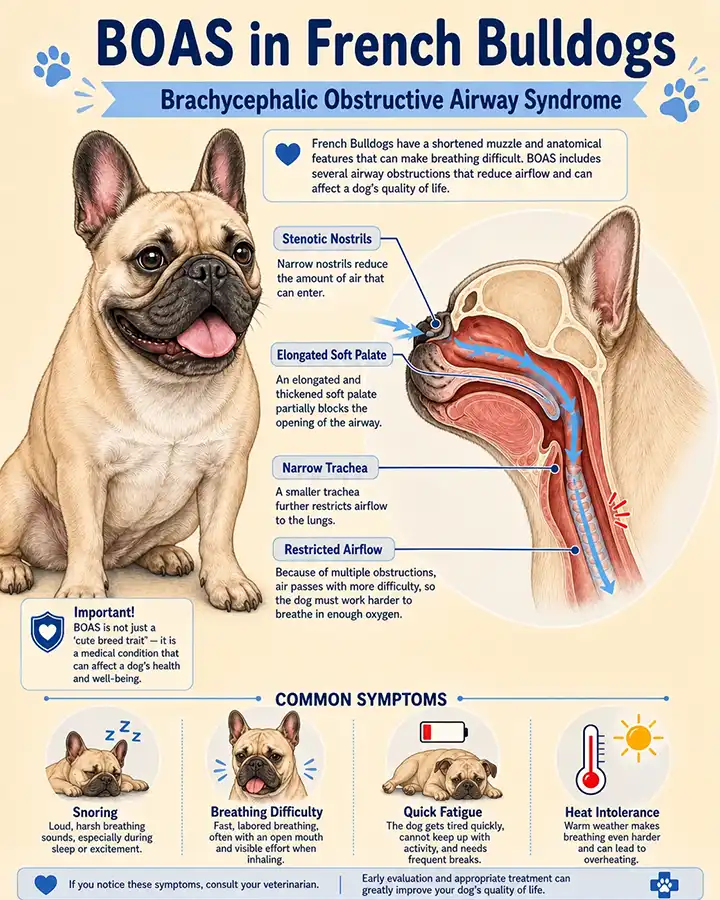
BOAS stands for Brachycephalic Obstructive Airway Syndrome. It's a breathing disease caused by the flat-faced shape of the French Bulldog skull. The bones are short, but the soft tissue inside — soft palate, tongue, nasal turbinates — is full size. So it gets crammed into a smaller space and blocks airflow.
Think of trying to breathe through a straw stuffed with a wet sponge. That's the everyday reality of most Frenchies.
The four anatomical problems
- Stenotic nares — narrowed nostrils that restrict airflow.
- Elongated soft palate — tissue at the back of the throat hangs into the windpipe.
- Overgrown nasal turbinates — the scrolls of bone inside the nose extend further back than they should.
- Hypoplastic trachea — in some dogs (mainly English Bulldogs) the windpipe is narrower than normal.
Many dogs also develop secondary collapse of the laryngeal saccules and voice box over time, especially when BOAS isn't managed early.
II. "Isn't That Just How Frenchies Sound?"
This is the most damaging myth in the breed. Most owners — and many general-practice vets — assume that snoring, snorting, and noisy breathing are "just Frenchie traits."
They're not. They're symptoms of a disease. A healthy Frenchie should breathe quietly when resting.
FORUM FINDING (French Bulldog News forum) — UNOFFICIAL FINDING: He sounded like a piglet at rest. We thought it was cute. Three years later we learned it was Grade II BOAS.
III. The 8 Warning Signs Owners Regret Ignoring
- Loud snoring or snorting at rest — not when running, at rest.
- Stops mid-walk to catch breath ("planting") — the #1 sign owners say they wish they'd taken seriously.
- Gagging, retching, or "honking" after excitement.
- Sleeping with head propped up, sitting upright, or with a toy in mouth — self-management tricks because flat sleeping = airway collapse.
- Frequent reverse sneezing — note how often it happens and tell your vet, especially if it is several times a day.
- Regurgitation, white foam, or drooling — GI symptoms are very common in Frenchies with BOAS.
- Heat intolerance — refusing to walk in mild heat (22°C / 72°F+). If he collapses in the heat, it is an emergency: cool him right away and call the vet while you cool him.
- Blue / purple gums (cyanosis) — this is an ER sign, not a daily one.

"Spike lives in tropical heat year-round. We learned the hard way that walks during the day weren't an option. Now: 5:30 AM walk, indoor day with A/C, 8:30 PM walk. The A/C goes on whenever it's above 22°C (72°F) — that's non-negotiable."
IV. What Triggers a BOAS Crisis
Heat is the deadliest trigger. Body temperature above 43°C / 109°F has a high death risk in dogs. Once they overheat, flat-faced dogs have about 3 times the odds of dying of heat-related illness compared with medium-muzzled dogs (Hall et al. 2022).
Common triggers, ranked by danger:
- Heat + humidity — humid 24°C (75°F) feels worse than dry 28°C (82°F).
- Exercise, especially after eating.
- Excitement — visitors arriving, doorbell, the start of a walk.
- Stress — vet visits, travel, separation.
- Eating fast (gulping air → reflux → secondary breathing struggle).
Owners knew this for years before research caught up: a Frenchie can be in real trouble at temperatures a long-nosed dog handles without effort. Our opinion: 24°C (75°F) is the absolute upper limit for a walk — never above it, and even at 24°C (75°F) we don't recommend it.
And a warning from the Caribbean, because here the thermometer lies. In high humidity Spike struggles at temperatures that would affect him much less in a dry climate: panting only cools if the air can take up the moisture he breathes out, and here the air is already full. Our opinion: that is why, in the tropics, the rule is not “avoid midday” — midday does not exist: an early-morning walk, a walk after dark, and A/C the rest of the day. If you live in the Caribbean, Central America, on the Mexican coast, in Florida, or in South Texas, your real limit is lower than the number on the thermometer.
V. Daily Management That Actually Works
Our opinion: weight + harness + heat avoidance is the foundation (the Cambridge BOAS Research Group recommends weight loss). Surgery is the icing — daily management is the cake.
The proven owner toolkit
- Always walk him in a harness, never on a collar. A back-clip Y-shape harness is best.
- In summer, walk him only at dawn and after sunset.
- Do the 7-second pavement test — hold the back of your hand on the asphalt. If you can't hold it there for 7 seconds, it is too hot.
- Use a slow-feeder bowl or an elevated bowl — it kills the air-gulping that drives reflux.
- Give him wet food or kibble soaked in water — it is easier to swallow.
- Feed him several smaller meals — 3-4 per day, not 1-2 big ones.
- Turn the A/C on whenever it is warmer than 22°C (72°F) indoors.
- In summer, use a cooling vest — soak it first, and make sure two fingers fit under it.
- Weight management. In pugs and bulldogs extra body fat is linked to BOAS (Liu et al. 2017); in French Bulldogs the link was not clear — keep him lean anyway.
- Never fly a Frenchie in cargo.
VI. Vet Visit vs ER — How to Tell
Routine vet visit (within days or weeks)
- New or worsening snoring at rest.
- Increased exercise intolerance.
- Frequent reverse sneezing or daily regurgitation.
- Sleeping changes (needs head propped up to breathe).
- BOAS Functional Grading test — a 3-minute trot test that grades severity; the Kennel Club scheme repeats it every two years.
Emergency room — go NOW
Blue, purple, or gray tongue / gums. Collapse or fainting. Open-mouth gasping with neck extended. Body temperature above 40°C / 104°F. Foaming + breathing distress that won't calm in 2-3 minutes.
The rule: if you're asking yourself if it's bad enough for the ER, it is.
VII. Surgery — What Owners Need to Know
BOAS surgery is recommended for Grade III dogs and considered for Grade II (together with weight loss), ideally before age 2 and before laryngeal collapse develops.
What surgery actually does
Surgeons widen the nostrils (ala-vestibuloplasty), shorten the soft palate (staphylectomy or H-pharyngoplasty), and remove everted laryngeal saccules. The goal: physically open up the airway.
What the data says
- In a JAVMA study of 423 dogs (one surgical technique), owners reported better breathing in 72% of dogs.
- Fewer digestive signs in 34% of dogs.
- Best outcomes: dogs under 2 years old, before laryngeal collapse.
- In that study 2.6% of dogs died after surgery and 2.1% had serious breathing trouble; a temporary breathing tube is sometimes needed (Cornell).
What surgery does NOT do
Surgery doesn't make a Frenchie a Labrador. In a Cambridge study of 50 dogs, the median BOAS index fell from 76% to 63% after surgery (Liu et al. 2017) — better, but still affected. Many dogs still snore after surgery, just less.
Estimated cost ranges
We found no official figure for this. Prices vary a lot by country and by clinic — ask for a written quote before surgery.
VIII. 10 Common Owner Mistakes
- Frenchies do NOT "just sound like that." The most damaging myth.
- NEVER walk him on a collar — harness only. Pressure on a compromised airway = worse breathing.
- Keep him lean — fat squeezes the airway from the inside.
- Ask your vet about BOAS Functional Grading — even if "he seems fine." The Kennel Club scheme repeats it every two years.
- Do NOT wait until age 4-5 for surgery — outcomes are best before age 2. Outcomes drop sharply after laryngeal collapse develops.
- NEVER let him play hard in heat "just for 5 minutes."
- Use a slow-feeder or elevated bowl — never a flat bowl on the floor with regular kibble.
- NEVER put him in the cargo hold — airlines like Lufthansa and Air France ban flat-faced breeds from cargo because that is where they die (about half of the purebred dogs that died on US flights in 2005–2010 were flat-faced breeds). If you must fly, it is cabin only, in a carrier under the seat, with a vet check 7–10 days before — and no sedation, which makes breathing worse at altitude. Cargo flights have killed many brachycephalic dogs.
- Track his snoring year to year — if it gets worse, the disease is progressing.
- Do not confuse reverse sneezing with choking. If you are not sure which one it is, treat it as an emergency and call your vet right away.
No-pull Y-shape harness — after trying a few with Spike, this is the one I trust. It fits his wide chest and keeps everything off the neck, which is the whole point for a dog whose airway is already narrow.
See it on Amazon → Affiliate link — as an Amazon Associate I earn from qualifying purchases.Owners Also Ask
Do all French Bulldogs have BOAS?
Most show some signs. In a Cambridge study of 214 French Bulldogs, about 9 in 10 showed at least mild breathing signs and about 6 in 10 had BOAS that needs care (Liu et al. 2017). What varies is severity — from mild Grade I to surgical Grade III. That’s why the BOAS Functional Grading test (a 3-minute trot test) matters: it tells you where your dog actually stands instead of guessing.
Is snoring normal for a Frenchie?
No — and this is the most damaging myth in the breed. A healthy Frenchie should breathe quietly when resting. Loud snoring, snorting, or “piglet noises” at rest are symptoms of airway obstruction, not personality traits. If the noise gets worse year over year, the disease is progressing.
How much does BOAS surgery cost?
We found no official figure for this. Prices vary a lot by country, by region and by whether a board-certified surgeon does it; ask for a written quote. The bigger cost driver is waiting too long — outcomes drop sharply once laryngeal collapse develops.
Does surgery cure BOAS?
It helps a lot, but it doesn’t make a Frenchie breathe like a Labrador. In a JAVMA study of 423 dogs, owners reported better breathing in 72% of dogs; in a separate Cambridge study, the median BOAS index fell from 76% to 63% — better, still affected. Many dogs still snore after surgery, just less. Daily management (weight, harness, heat avoidance) stays essential for life.
At what temperature is it too hot to walk a Frenchie?
Our opinion: 24°C (75°F) is the absolute upper limit — never above it, and even at 24°C (75°F) we don't recommend a walk. Below that, skip the walk when it is humid. A Frenchie can be in trouble even below these limits — every dog handles heat differently. Walk at dawn and after sunset in summer. If your dog overheats anyway, cool first, drive second — that order saves lives.
References
- O'Neill et al. (2021). "French Bulldogs differ to other dogs in the UK in propensity for many common disorders." VetCompass. PMC8675495
- Cambridge BOAS Research Group — Recognition & Diagnosis. cam.ac.uk
- Liu et al. 2017 — BOAS in pugs, French bulldogs and bulldogs (PLOS ONE). PMC5538678
- Liu et al. 2017 — BOAS index before and after surgery (Veterinary Surgery). doi.org
- Hall et al. 2022 — Heat-related illness in UK dogs. PMC9144152
- American Kennel Club — French Bulldog. AKC.org
- Royal Kennel Club Respiratory Function Grading Scheme. thekennelclub.org.uk
- JAVMA 2022 — H-pharyngoplasty outcomes in 423 dogs. avma.org
- JVIM 2024 — Wireless pH monitoring of GERD in Frenchies (Ullal). wiley.com
- Cornell Riney Canine Health Center — BOAS. cornell.edu