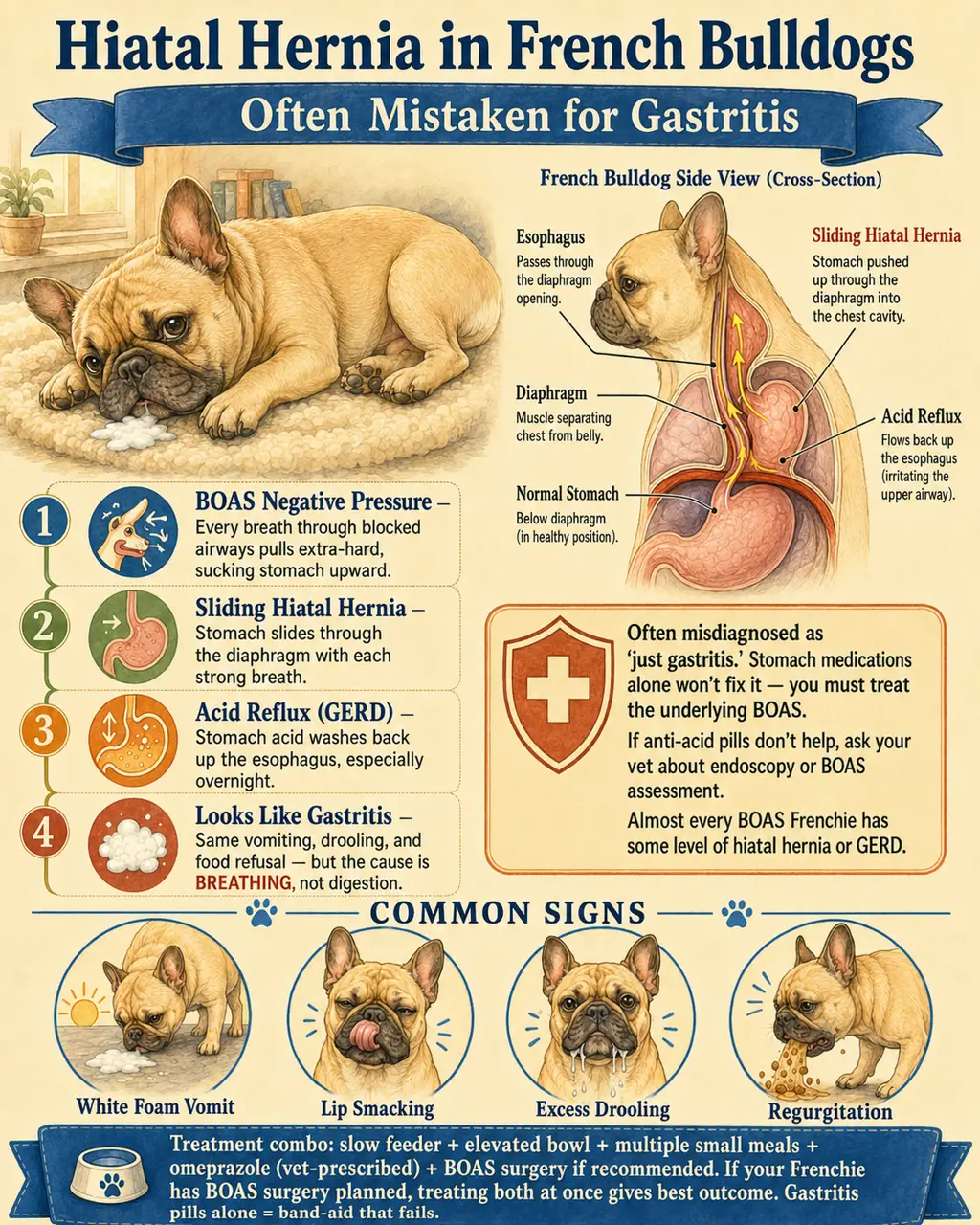
The white-foam morning vomit. The loud post-meal burp. The slow, careful eating. Most owners are told this is "just a Frenchie thing." It isn't — it's mechanical, predictable, and usually downstream of BOAS.
I. What It Is
Sliding hiatal hernia (SHH) — part of the stomach pushes upward through the diaphragmatic hiatus into the chest cavity.
In Frenchies it's almost always paired with GERD (gastroesophageal reflux disease) — stomach acid sliding back into the esophagus, burning the lining, chronic irritation.
Not a "weird random thing." In this breed it's mechanical and predictable.
II. Why Frenchies Are Prone — It's BOAS
The driver is BOAS — Brachycephalic Obstructive Airway Syndrome.
Narrowed nostrils + elongated soft palate + small windpipe → the dog sucks in air against resistance → every hard breath creates profoundly negative intrathoracic pressure → literally vacuums stomach upward through the diaphragm.
Add aerophagia (gulping air while eating) + esophageal dysmotility + obesity = perfect storm.
Pankratz et al. (PMC9673814): GI signs (regurgitation, ptyalism, dysphagia, reflux, flatulence) occur in ~97% of brachycephalic dogs with respiratory signs. Severity of airway signs = severity of GI signs.
By the time you see distress, the esophagus has been bathing in acid for years.
III. 2024 Wireless pH Monitoring
Ullal et al., JVIM:
- UC Davis prospective cohort: French Bulldogs with type I sliding hiatal hernia (2021–2022).
- Median age 21 months, median weight 10 kg.
- Wireless intra-esophageal pH capsules (human gold standard).
- Median acid exposure time: 3.3%.
- Median 70 reflux events per dog.
- Critically: subclinical reflux captured — events the owner never sees because the dog doesn't visibly regurgitate.
- After BOAS surgery, all 4 dogs that underwent the procedure showed numerical improvement in acid exposure time.
IV. BOAS Surgery Improvement
- Broader literature: 91.4% of patients show GI improvement after multilevel airway correction.
- Mayhew 2023 Veterinary Surgery trial (16 dogs): owner-perceived improvement in regurgitation.
- BUT videofluoroscopy did NOT show consistent resolution of the hernia/reflux itself.
- Translation: surgery often quiets the symptoms even when the mechanical hernia persists.
- Why specialists increasingly bundle laparoscopic hiatal hernia repair concurrent with BOAS surgery for severe cases.
V. Symptoms Owners Must Learn
- Regurgitation (passive — food just falls out, no abdominal heave).
- White foam vomit (the classic Frenchie morning gurgle).
- Gulping/swallowing repeatedly.
- Slow careful eating.
- Gagging.
- Lip-licking.
- Restless sleep.
- Snorting/snuffling after meals.
Many Frenchie owners chalk these up to "just being a Frenchie." They are not normal. They are reflux.

"Spike's bowl is on a slow-feeder mat — no exceptions. Smaller meals 3 times a day, never within 2 hours of bedtime, and a few minutes of standing time after dinner. The morning white foam stopped within a week."
VI. Diagnosis — What Vets Use
- Contrast (barium) videofluoroscopy — standard, dog swallows barium, radiologist watches the hernia slide in real time.
- Endoscopy — adds esophagitis grading + lower-esophageal-sphincter assessment.
- Wireless pH monitoring — new gold standard but limited to academic centers.
VII. Conservative Treatment — Most Frenchies Start Here
All reflux medications below must be prescribed by your vet. Wrong dose or interaction can damage your Frenchie's kidneys or liver.
- Omeprazole (proton pump inhibitor) — typical reference 1 mg/kg twice daily, vet decides exact dose. Reduces acid production.
- Sucralfate — coats and protects ulcerated esophageal lining; given 30–60 min apart from omeprazole.
- Slow-feeder bowl or snuffle mat — kills aerophagia, the root accelerator.
- Smaller, more frequent meals (3–4×/day instead of 2).
- Elevated feeding + keep dog upright with front feet on a chair for 10–15 min after eating (gravity helps).
- Weight loss if obese — single biggest lever.
- NEVER feed within 2–3 hours of bedtime — overnight reflux = esophagitis.
VIII. Surgical Options
- Hiatal hernia repair (cruroplasty + gastropexy ± esophagopexy).
- Increasingly done laparoscopically.
- Specialists strongly recommend doing it at the same anesthesia event as BOAS surgery — one recovery, addresses cause and consequence together.
IX. Common Owner Mistakes
- Ignoring "white foam puke" as harmless = chronic acid burn.
- Feeding right before bed.
- Letting the dog inhale food from a flat bowl.
- Skipping BOAS surgery because "he breathes fine" — by the time you see distress, the esophagus has been bathing in acid for years.
- Stopping omeprazole the day symptoms quiet — esophagitis takes weeks to heal.
Owners Also Ask
Why does my French Bulldog throw up white foam in the morning?
The classic morning white foam is stomach acid that refluxed into the esophagus overnight — not “just a Frenchie thing.” In this breed it’s usually mechanical: hard breathing against a BOAS-narrowed airway creates negative chest pressure that pulls the stomach upward, and acid follows. Occasional once-a-year foam isn’t panic material, but a weekly pattern deserves a vet conversation — chronic acid burns the esophageal lining.
What’s the difference between regurgitation and vomiting?
Vomiting is active — heaving, abdominal effort, warning signs. Regurgitation is passive: food or foam simply falls out, often minutes after eating, with no heave at all. Regurgitation is the reflux signature, and it’s the sign vets most want to hear about, because many owners never mention it (“he just spits up sometimes”).
What can I do at home to reduce reflux?
The mechanical layer works well: a slow-feeder bowl or snuffle mat (kills air-gulping), 3–4 smaller meals instead of 1–2 big ones, elevated feeding with 10–15 minutes upright after eating, weight loss if needed — and never feed within 2–3 hours of bedtime, because overnight reflux is what causes esophagitis. Medication (omeprazole, sucralfate) is a vet decision, not a DIY one.
Does BOAS surgery fix the reflux too?
Usually it helps a lot: the broader literature reports ~91% of dogs improve GI signs after multilevel airway surgery, and a 2024 pH-monitoring study saw acid exposure improve in every dog measured after the procedure. But imaging shows the hernia itself often persists — surgery quiets the symptoms without always fixing the mechanics. For severe cases, specialists increasingly repair the hiatal hernia laparoscopically during the same anesthesia as the BOAS surgery.
Can I just give my dog omeprazole myself?
No — reflux medication needs a veterinary prescription and an exact dose for your dog’s weight and organ function. And the most common medication mistake isn’t starting it, it’s stopping it the day symptoms quiet down: an acid-burned esophagus takes weeks to heal, so vets typically continue treatment well past the last visible symptom.
References
- Ullal et al. 2024 — Wireless pH monitoring. PMC11099765
- Mayhew 2023 — Vet Surgery BOAS+GI. Wiley Online Library
- BOAS + GI review. PMC9673814
- Aerodigestive disorders in Frenchies. Dvm360.com
- VVS BOAS patient overview. VVS.vet
- VCA hiatal hernia. VCAhospitals.com