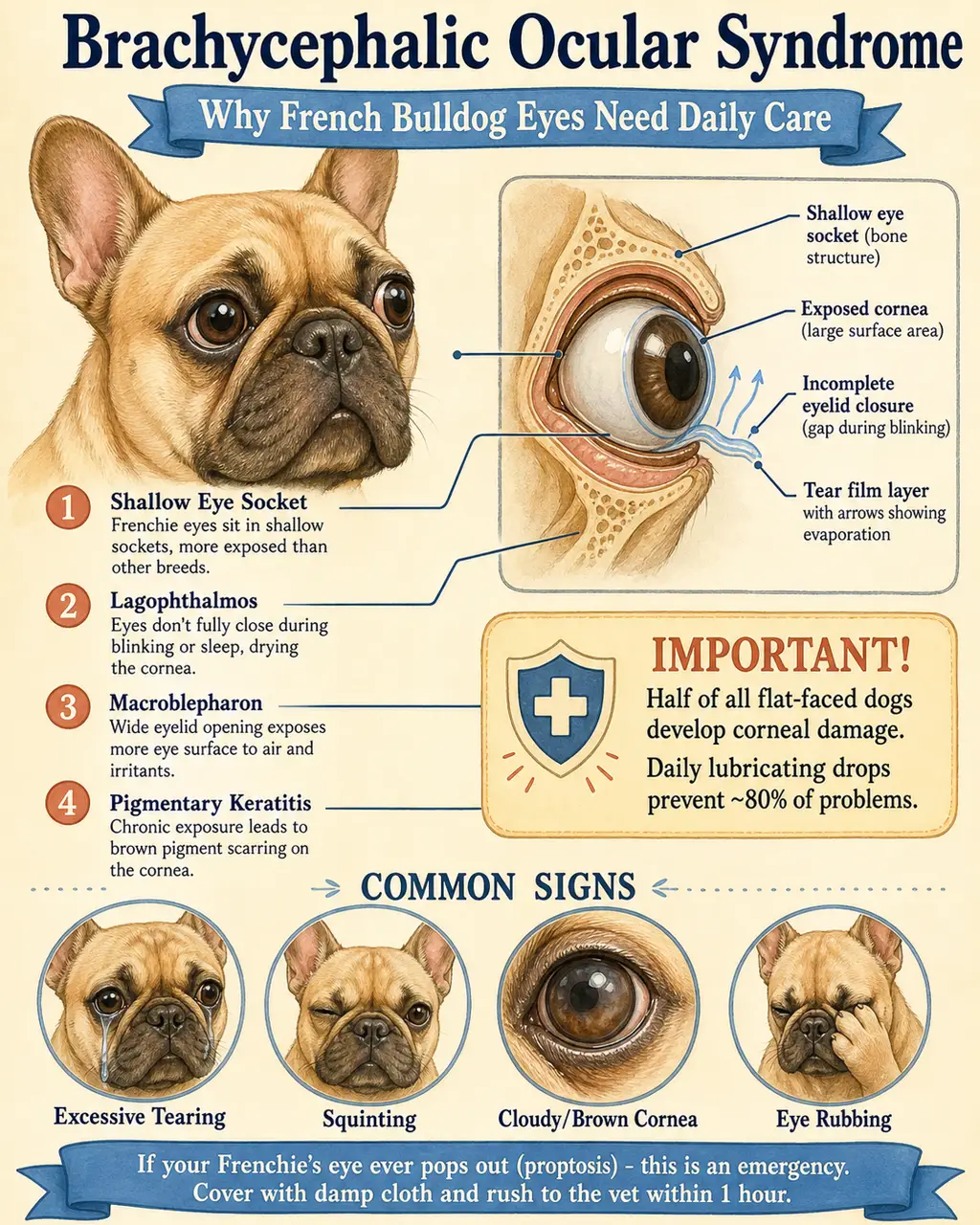
Big bulging eyes look cute — but they're also exposed and unprotected. About half of all flat-faced dogs have corneal damage by adulthood. Daily eye drops prevent 80% of problems. And if your Frenchie's eye ever pops out of socket — RUN to the ER.
Eye out of socket (proptosis) — keep moist with sterile saline, do NOT push it back, ER within 1-2 hours. Visible corneal ulcer or hole (descemetocele, perforation). Sudden cloudiness with severe pain (squinting, won't open eye). Profuse green/yellow discharge with redness appearing suddenly. Blood in or behind the eye (hyphema). Severe trauma (hit by car, dog fight, fall) — even if eye looks OK.
I. What BOS Is
BOS = Brachycephalic Ocular Syndrome. Not one disease — a syndrome where shallow eye sockets, exposed corneas, large eyelid openings, incomplete blinking, and abnormal eyelashes all combine to chronically damage the ocular surface.
Sebbag et al. 2023 (Veterinary Ophthalmology) called it a "pandemic of ocular surface disease," driven by demand for flat-faced breeds.
II. The 9 Components of BOS
- Shallow eye sockets (exophthalmia) — globe sits more exposed/forward, little bony protection
- Macroblepharon — excessively wide eyelid opening
- Lagophthalmos — incomplete blinking, especially during sleep
- Pigmentary keratitis — brownish-black melanin on cornea from chronic irritation
- Medial canthal entropion — inner corner eyelid rolls inward; nasal hairs/folds rub cornea
- Trichiasis / distichiasis — abnormal eyelashes scrape cornea
- Exposure keratitis / corneal ulceration
- Tear film instability (qualitative dry eye — see KCS)
- Proptosis risk — globe can pop out of socket from minor trauma
III. How Common — Sebbag 2023
Based on a sample of 93 brachycephalic dogs (38 of them Frenchies):
| Condition | Frequency |
|---|---|
| Macroblepharon | 47% |
| Corneal ulcers | 44% (and 11.18× odds vs crossbreeds) |
| Corneal pigmentation | 36% |
| Corneal fibrosis (scarring) | 25% |
| Entropion | 22% |
| Trichiasis | 16% |
| Distichiasis | 16% |
| KCS | 12% |
IV. Eye Injuries from Minor Trauma
Frenchie eyes protrude and don't have full blink protection. Everyday events cause damage:
- Swat from another dog or cat → corneal scratch
- Running through bush, branch, tall grass → ulcer
- Bedding fibers, hay, mulch → corneal abrasion
- Self-trauma when scratching face → ulcer
- Wind exposure on car rides → cornea dries enough to irritate
V. Daily Prevention — The Highest Leverage Habit
- Lubricating artificial tears (preservative-free) 1-3× daily, every day for life — Hylo-Tears, GenTeal, I-Drop Vet Plus
- Wipe inner corner with sterile saline pads daily — debris, mucus, irritants from skin folds
- Examine eyes daily under good light — cloudy spots, redness, squinting, brown pigment
- Hydrating eye gel at bedtime — combats overnight lagophthalmos
- Avoid grass/branches at face height on walks
- No rough play with eye-level hazards
- Annual ophthalmology exam (not just GP) — ACVO recommends
The corneal damage is preventable with daily hygiene + lubrication. But most owners only start AFTER damage. "Wait and see" with Frenchie eyes costs vision and money. Owners who do daily eye care from puppyhood report dramatically fewer ER visits and ulcer episodes.
VI. Surgery Options
- Medial canthoplasty — partial closure of inner eyelid corner. Gold-standard surgical fix for BOS. Reduces eye aperture, corrects medial entropion, improves tear distribution, removes nasal hairs from corneal contact.
- Standard entropion repair (Hotz-Celsus) — for lateral entropion only; success 90-95%
- Tarsorrhaphy — temporary partial eyelid suturing for proptosis recovery
- Conjunctival grafts — for deep ulcers
- Corneal grafting — for perforations or severe pigmentary keratitis
VII. Pigmentary Keratitis Treatment
- Topical cyclosporine 0.2% (Optimmune) — primary, slows progression
- Topical tacrolimus — more potent alternative
- Topical corticosteroids — only when no ulcer present (steroids worsen ulcers)
- Pigment usually does NOT regress fully — goal = STOP further progression
- Surgery (superficial keratectomy) for advanced vision-threatening cases — but pigment often returns
VIII. Proptosis Specifically
Approximately ≥72% of proptosed eyes lose vision even with surgery (only ~28% retain useful vision per Today's Veterinary Practice). Time-to-treatment is the biggest factor. Frenchies are among the highest-risk along with Pugs and Pekingese (shallow orbits).
Daily lubricating drops, a saline wipe at the inner corner, and one annual ophthalmology exam — that single routine prevents most of what we see in the ER.
References
- Sebbag 2023 — Pandemic of Ocular Surface Disease in Brachycephalic Dogs. Wiley Online Library
- Clinical signs of BOS in 93 dogs. PMC7836154
- VetCompass — Corneal Ulcerative Disease. PMC5471714
- Today's Veterinary Practice — Addressing BOS. TodaysVeterinaryPractice.com
- Clinician's Brief — Top 5 Ocular Complications of Brachycephaly. CliniciansBrief.com
- VCA — Pigmentary Keratitis. VCAhospitals.com