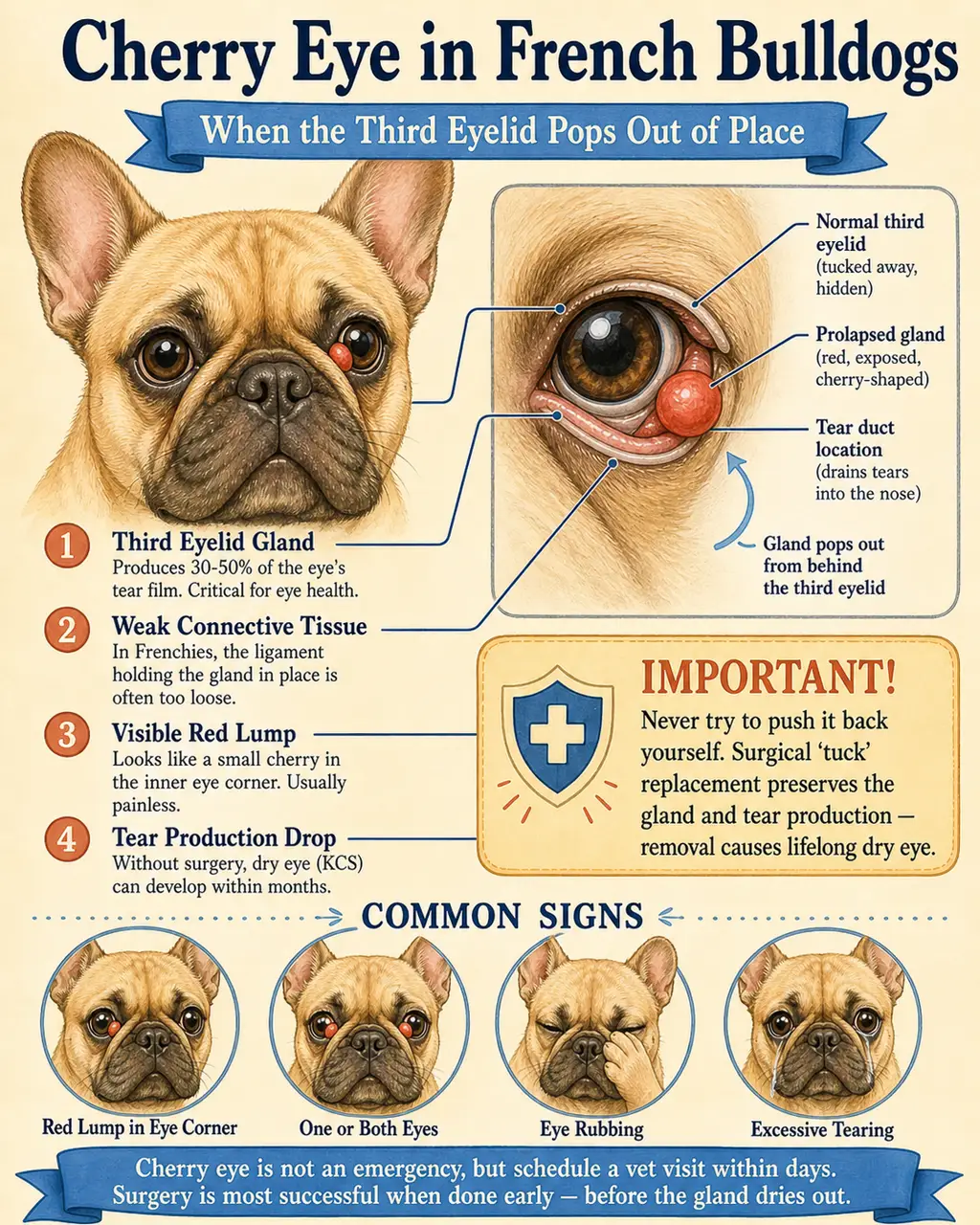
A red lump in the corner of your Frenchie's eye? That's cherry eye — a tear gland that popped out of place. The #1 vet mistake is REMOVING the gland. Studies show 13-68% develop chronic dry eye after removal. Always ask for replacement.
I. What It Is
The tear-producing gland tucked behind the third eyelid (nictitating membrane) pops out of position and bulges visibly in the inner corner of the eye. It looks like a small red cherry — hence the name.
The gland itself isn't damaged at first, just out of place. Doesn't hurt the dog initially, but if exposed it dries out, swells, gets irritated, and leads to chronic problems.
II. Why Frenchies Are Prone
The third eyelid gland is held by a small fibrous attachment to the orbital rim. In Frenchies, connective tissue is genetically weak and lax + brachycephalic shallow eye sockets give the gland more room to "flip" out. Structural and genetic — not owner-caused.
III. Prevalence — VetCompass 2022
Population data from VetCompass 2022, n=905,553:
- Overall canine: 0.20%/year
- French Bulldog: 1.22%/year — 6× breed average
- Odds ratio: 8.22× vs crossbreeds
- 4th most predisposed breed (after Neapolitan Mastiff, English Bulldog, Cane Corso)
- Brachycephalic skull = ~7× higher odds than mesocephalic
IV. Age of Onset
- Median age (all breeds): 0.63 years (~7-8 months)
- Most Frenchies: before 2 years
- First prolapse often at 4-12 months (puppy stage)
V. Surgical Options
Tucking / Replacement (PREFERRED)
- Morgan pocket technique — gland sutured back into a conjunctival pocket
- Orbital rim anchor technique — gland anchored to the periosteum
- Combined pocket + anchor = best for Bulldogs (3.2% recurrence vs 11.9% Morgan alone)
- Saves the gland → preserves tear production
- Success rate (board-certified ophthalmologist): ~92%
Excision / Removal (NOT RECOMMENDED — major vet mistake)
- Nictitans gland produces ~35% of tear film
- Removal increases KCS risk dramatically — studies report a wide range (13-68% develop KCS depending on technique, breed, and follow-up time)
- Replacement preserves tear function and lowers KCS risk significantly
- Sets dog up for lifelong dry eye (see KCS)
If your vet recommends removing the gland, get a second opinion from a board-certified veterinary ophthalmologist. The replacement procedure is more technically demanding but it preserves your dog's tear function for life. This is the single highest-leverage decision you'll make about your Frenchie's eye health.
If one pops, monitor the other — often follows within months.
VI. Recurrence Rates
- General after replacement: 5-10%
- Bulldogs/Frenchies higher (lax connective tissue)
- Combined pocket + anchor reduces recurrence significantly
One Eye vs. Both
Cherry eye usually starts in one eye, but both eyes are commonly affected eventually. Forum consensus: "If one pops, monitor the other — often follows within months."
Pre-Surgery Management
- Lubricating eye drops (artificial tears) every few hours
- Keep dog from rubbing (E-collar / cone)
- Don't wait too long — chronic prolapse = gland swells/fibroses, harder surgery, worse outcome
VII. Cost — USD 2025
| Procedure | Typical cost |
|---|---|
| General GP — replacement | $300-$1,500 |
| Most common range | $500-$1,200 |
| Board-certified ophthalmologist | $1,500-$2,500+ |
| Both eyes at once | $800-$2,000+ |
| Post-op rechecks | $50-$100 each |
The specialist cost is worth it — better technique = lower KCS risk + lower recurrence.
VIII. Common Vet Mistakes
- Recommending excision instead of replacement
- Repeatedly "popping it back" without surgery
- Simple sutures without orbital anchor in Bulldogs (high recurrence)
- GP attempting complex Bulldog cases instead of referring to a specialist
References
- VetCompass PNMG study, RVC 2022. PMC8791520
- Evidence-Based Surgical Techniques Review. PMC6163435
- ACVO — Cherry Eye. ACVO.org
- Cornell Riney Canine Health — Cherry Eye. Cornell.edu
- VetTimes — Cherry Eye Re-Emerging Problem. VetTimes.com