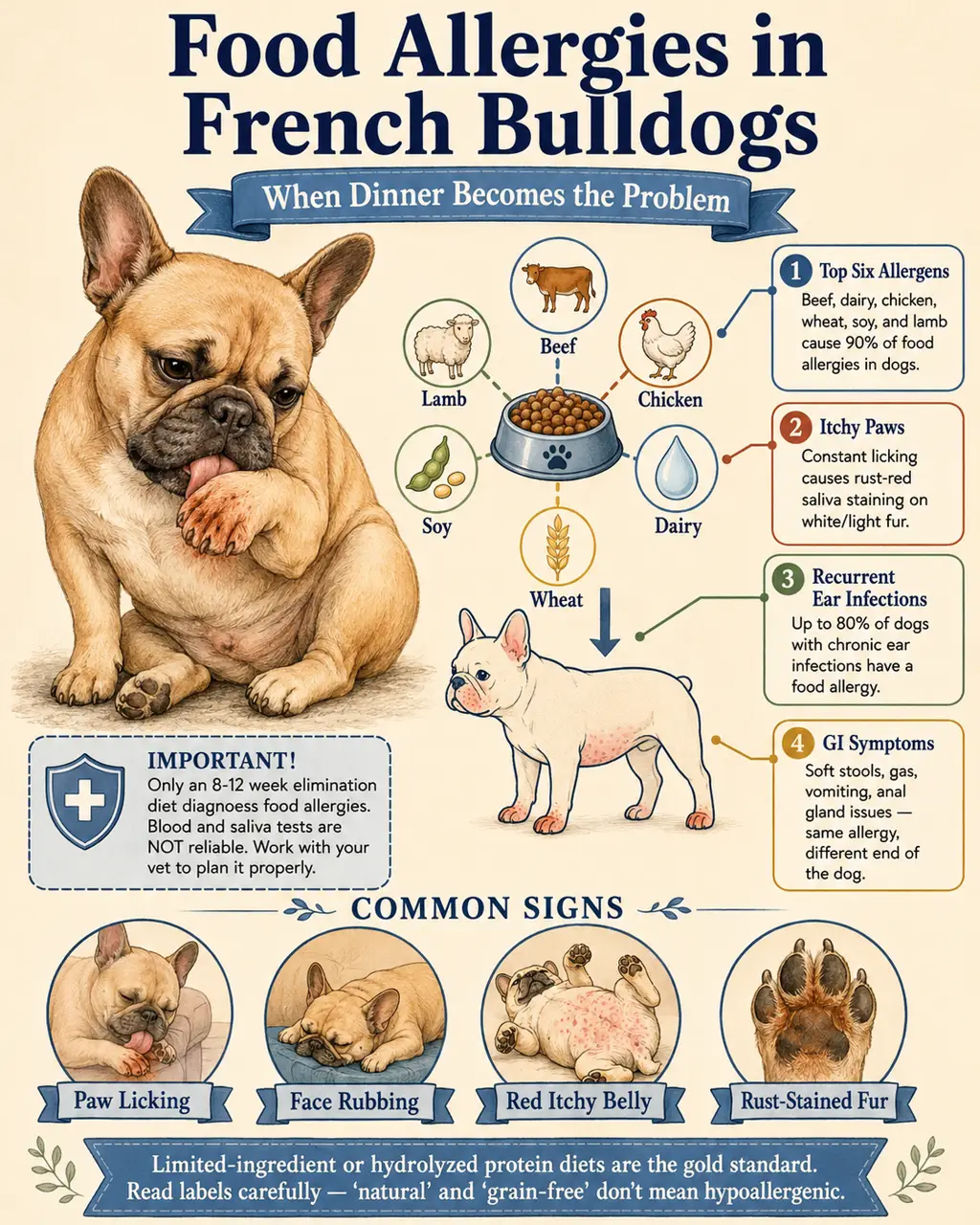
Itchy paws? Recurring ear infections? Year-round skin problems? Most owners get told it's "just allergies" and switch foods every few weeks — and stay stuck. The only diagnosis that actually works takes 8 weeks of total commitment — ask your vet about an elimination diet.
I. What Food Allergies Actually Are
An immune-mediated reaction — the immune system mistakes a harmless protein for a threat, triggering inflammation in skin, ears, and gut. Different from intolerance, which is not an immune reaction.
VetCompass 2021 (2,781 Frenchies vs 21,850 other dogs)
- Food hypersensitivity, odds ratio (OR): 6.96 (95% confidence interval 4.61–10.51)
- Allergic skin disorder OR: 7.68
- Skin fold dermatitis OR: 11.18 (Frenchies vs other dogs)
II. Why Frenchies Get Hit Hardest
- Gut-skin axis — scientists estimate that roughly 70–90% of the immune system sits in the gut (Cornell), and dogs with atopic skin disease have different gut bacteria (one small study, 2025).
- Genetics — Frenchies have about twice the odds of an atopic dermatitis diagnosis compared with other dogs (VetCompass 2021).
III. The Top Allergens Ranked
Mueller, Olivry & Prélaud 2016 reviewed 297 dogs with confirmed food allergies. The result is the cleanest ranking we have:
| Rank | Allergen | % of allergic dogs |
|---|---|---|
| 1 | Beef | 34% |
| 2 | Dairy | 17% |
| 3 | Chicken | 15% |
| 4 | Wheat | 13% |
| 5 | Soy | 6% |
| 6 | Lamb | 5% |
| 7 | Corn | 4% |
| 8 | Egg | 4% |
| 9 | Pork | 2% |
| 10 | Fish (tied with rice) | 2% |
Beef, dairy, chicken and wheat were the four most often reported (34%, 17%, 15% and 13% of dogs; many dogs reacted to more than one). Fish ranks low probably because few dogs in those studies had eaten it — the ranking may simply reflect what dogs were fed (Mueller 2016).
Owners are sold "grain-free" food while their dog is allergic to beef. Corn allergy: 4%. Wheat: 13%. Beef: 34%. Read the protein on the label, not the marketing.
IV. Food vs Environmental Allergies
| Sign | Food | Environmental |
|---|---|---|
| Timing | Year-round constant | Often seasonal |
| GI signs | Often (vomiting, soft stool, gas) | Rare |
| Ear infections | Chronic year-round | Possible seasonal |
| Medicines | If medicines clear the itch completely, a food allergy is less likely (Today’s Veterinary Practice) | |
Frenchie-specific signal: chronic year-round ear infections. Ear infections are one of the most common signs of food allergy (reported in 3–69% of food-allergic dogs, depending on the study).
Our opinion: 3+ ear infections in 12 months — ask your vet about a food trial.
V. The Elimination Diet — Gold Standard
Olivry 2015 duration data
- Week 3: about 50% of dogs improved
- Week 5: over 80% of dogs improved
- Week 8: over 95% of dogs improved ← gold standard
How to do it
- Single novel protein + single novel carb (kangaroo + sweet potato, rabbit + pumpkin) OR prescription hydrolyzed diet (proteins broken into pieces too small for the immune system to recognize).
- Nothing else passes the lips for 8 weeks — no treats, toothpaste, table scraps, supplements, or rawhides. Medications and monthly preventives stay exactly as your vet prescribed — ask your vet how they fit the diet, never change them on your own.
- Provocation challenge — once symptoms resolve, reintroduce the original food. If symptoms return within 14 days = confirmed allergy. Then test single ingredients (start beef + dairy = highest yield).

"The hard part of the 8-week trial isn't the food — it's the family. One person sneaking a treat resets the whole clock. Tell everyone in the house: nothing passes the lips that isn't on the plan."
VI. What NOT to Do
- Do NOT use skin allergy tests to diagnose a food allergy — they are not validated for food.
- Do NOT buy blood IgE panels — false positives + false negatives.
- Do NOT buy saliva or hair tests — unvalidated, and tested: researchers sent in samples from an allergic dog, a healthy dog, five pieces of fake fur and plain water. The results were no better than chance, and re-sending the same sample gave a different answer (Coyner & Schick, Journal of Small Animal Practice, 2019). A second study that year reported positive results even for the fake fur and water (Veterinary Dermatology, 2019).
- Stop switching foods every few weeks — no diagnosis possible.
- Avoid "sensitive stomach" formulas with the same allergens — common trap.
VII. Lifelong Management
- Read every label — treats, dental chews, supplements, even toothpaste. For anything your vet prescribed, ask the vet about ingredients instead of changing it yourself.
- Watch hidden allergens: "natural flavor," "animal fat," "meat meal," "broth."
- Over-the-counter "limited ingredient" foods are often contaminated with other proteins — veterinary diets made for food trials are the safer choice (Tufts).
- Travel: pack 110% of food.
- Vet visits: ask the vet to write "no flavored medications, no treats" in your dog’s chart.
Owners Also Ask
What is the most common food allergen for French Bulldogs?
Beef, in the studies we have — mostly from Europe, North America and Australia. In the cleanest review we have (297 dogs with confirmed food allergies), beef was reported in 34% of the dogs, dairy in 17%, chicken in 15% and wheat in 13% (many dogs reacted to more than one). Fish and rice were at 2% each. One thing to keep in mind: the authors say the ranking may simply reflect what dogs were being fed at the time — it can differ where dogs eat different proteins. Your vet knows what is common where you live.
Do blood, skin, or saliva allergy tests work for dogs?
For food allergies — no. Skin testing isn’t validated for food, blood IgE panels produce both false positives and false negatives, and saliva tests are unvalidated entirely. The only diagnosis that holds up is an elimination diet of at least 8 weeks, followed by a provocation challenge. Anyone selling you a quicker shortcut is selling exactly that.
How long does an elimination diet take, really?
At least eight weeks, and your vet may extend it. The duration data: about 50% of dogs improve by week 3, over 80% by week 5, and over 95% by week 8 — stopping early is how trials fail. The other way they fail: anything off-plan passing the lips (treats, table scraps) resets the clock. Medications and monthly preventives stay as your vet prescribed — ask your vet. Then reintroduce the old food — symptoms returning within 14 days confirms the allergy.
Is it a food allergy or an environmental allergy?
The quickest tells: food allergies are year-round and constant, environmental ones are often seasonal. Food allergies frequently bring GI signs (soft stool, gas, vomiting) and chronic ear infections. Our opinion: 3+ ear infections in 12 months — ask your vet about a food trial.
Should I switch my allergic Frenchie to grain-free food?
Probably not — that’s the grain myth. Corn causes about 4% of confirmed food allergies and wheat 13%, while beef causes 34%. Owners get sold “grain-free” formulas while their dog reacts to the beef inside them. Read the protein source on the label, not the marketing on the front of the bag.
References
- Mueller, Olivry, Prélaud (2016). Common food allergens in dogs and cats. PMC4710035
- Olivry, Mueller, Prélaud (2015). Duration of elimination diets in dogs and cats. PMC4551374
- O'Neill et al. (2021). French Bulldogs differ to other dogs in the UK. VetCompass. PMC8675495
- Probiotics in atopic dermatitis. BMC Microbiology, 2025. PMC12012994
- Today's Veterinary Practice — Food Allergy Diagnostics. todaysveterinarypractice.com
- Tufts Petfoodology — Eliminating Mistakes in Elimination Diet Trials. tufts.edu