- COOL HIM NOW. Pour cold water over his whole body, nonstop, with a fan on.
- CALL WHILE YOU COOL. Put the phone on speaker and keep cooling. Can't do both? Keep cooling and ask someone to call the vet for you.
- STOP COOLING AT 103°F / 39.4°C. No thermometer? Stop as soon as he starts to shiver.
- DRIVE TO THE VET. Go even if he looks better. Turn the A/C on full. If someone else can drive, let them. Alone? Eyes on the road, not on the dog — a crash turns one patient into two.
Full guide below — read it when he is stable ↓
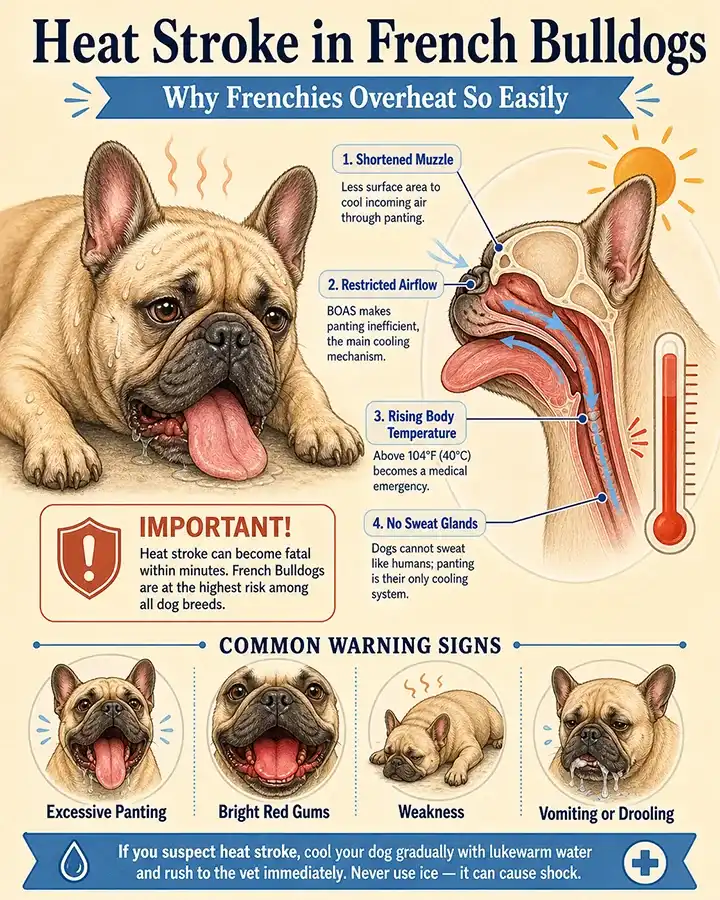
Dogs cool themselves by panting — moving hot air across moist tongue and lung surfaces. Frenchies have physically less surface area to do this, plus a windpipe that's often too narrow. Heat builds up fast and they can't get rid of it.
I. Why Frenchies Are About 6× More Vulnerable
An excited Frenchie can reach dangerous heat stress on a day a Labrador handles comfortably. The numbers, by breed:
- French Bulldogs: about 6.5× the odds of heatstroke vs Labradors (Hall, Carter & O'Neill 2020)
- English Bulldogs: 14×
- Pugs: 3×
- Heavier than the breed average, or over 2 years old = higher risk (all breeds)
- Dogs heavier than their breed average had about 1.4× the odds (all breeds; the study could not tell fat from muscle)
II. Body Temperature Thresholds
| Zone | Temperature | What it means |
|---|---|---|
| Normal | 38.1-39.2°C / 100.5-102.5°F | Healthy at rest |
| Warning | 39.5-40°C / 103-104°F | Stop activity, cool |
| Heatstroke | ≥40.5°C / 105°F | Emergency — start cooling NOW |
| Critical | ≥41°C / 105.8°F | Nervous system dysfunction begins |
| Death zone | ≥43°C / 109.4°F | Mortality climbs sharply |
How long he stays above 43°C (109°F) matters as much as the peak — every minute matters.
III. Air Temperature — When Walks Become Dangerous
- Our opinion: 24°C / 75°F is the absolute upper limit. Never walk above it, and even at 24°C (75°F) we don't recommend it. This is our own rule, not an official limit.
- 20–24°C / 68–75°F — walk only early in the morning or after sunset, and skip the walk when the humidity reaches 82% at 20°C (68°F), 80% at 21°C (70°F), 78% at 22°C (72°F), or 75% at 24°C (75°F).
- Heatstroke can happen even below these limits — an excited Frenchie heats up fast, so watch him the whole walk.
Place the back of your hand on the sidewalk and hold it for 7 seconds. If you can't, your Frenchie can't either. Pavement at 52°C (125°F) can burn skin in 60 seconds (human-skin data, cited by Washington State University) — and radiates heat up into your Frenchie's belly because of their low ground clearance.
SGODA cooling vest — the one Spike actually wears when we have no choice but to go out in the Dominican heat. Soak it, wring it, put it on — I carry a small bottle of water to re-soak it halfway through the walk. Spike wears a Medium (52–61 cm / 20.5–24 in chest).
See it on Amazon → Affiliate link — as an Amazon Associate I earn from qualifying purchases.IV. Warning Signs — Escalating
Early (act now)
- Heavy panting at rest
- Seeking cool surfaces (tile floors)
- Reluctance to move
- Drooling more than usual
- Bright pink tongue
Mid (emergency)
- "Freight-train" panting
- Thick, ropy saliva
- Very red gums or ears
- Glassy eyes
- Wobbling, won't respond to name
Severe (life-threatening)
- Dark red, purple, or gray gums; blue tongue (cyanosis)
- Collapse, vomiting, bloody diarrhea, seizures
- Body temperature ≥42°C / 107.6°F
- Unconsciousness
V. Cool First, Vet Second — Step-by-Step Response
Minute 0: Stop activity. Get him into the nearest shade, right where you are — don't delay the cooling to reach A/C or the car. Carry the dog — don't let them walk.
Minute 1-2: Get water on them. Cold water is correct and saves lives.
- Cold-water immersion (bathtub, kiddie pool, hose) — head OUT — for conscious, healthy Frenchies. Any water cooler than he is works; in the one lab study, conscious dogs cooled fastest at about 15–16°C (59–61°F) — ice-cold is not needed.
- Or continuous pour + fan — wet whole body, especially neck, chest, belly, paws.
Minute 3-10: Keep pouring cold water nonstop, and call the vet while you cool (or ask someone to call). Aim for rectal temp 39.4°C / 103°F — then STOP cooling (rebound hypothermia risk). No thermometer? Stop as soon as he starts to shiver.
After cooling: Transport to vet with A/C on full + wet towels under (not over) the dog.
Always go even if your dog seems "recovered." Clotting failure (DIC) and kidney failure can appear hours to days later — that is why vets watch the dog for at least 24–48 hours.

"We learned the hard way that walking during the day wasn't an option. Year-round routine: 5:30 AM walk, indoor day with A/C set to 22°C (72°F), 8:30 PM walk. Tile floor in the bathroom is Spike's favorite spot. Power outage = emergency — we have a backup battery for the A/C."
VI. What NOT to Do
- Don't drive to the vet without cooling first — dogs cooled before the drive have a better chance.
- Don't cover him with wet towels — they trap heat. Pour the water straight onto his fur.
- Don't pour rubbing alcohol on him — it can be absorbed through the skin and is not a recommended cooling method.
- Don't offer ice to chew or force water — he can breathe it in, and water or vomit in the lungs causes pneumonia.
- Don't cover him with a wet blanket, and don't close the car windows.
- The "tepid water only" advice is outdated — vets now recommend cold-water immersion for young, healthy dogs, or pouring water plus a fan for any dog.
Cooling Methods
| Method | Speed | Best for |
|---|---|---|
| Cold-water immersion (cool or cold water, head out) | Fastest | Conscious, healthy dogs |
| Evaporative (continuous pour + fan) | Fast | Senior, unconscious — works on any dog |
| Spraying with garden hose | Moderate | Backyard emergency |
| Wet towels over the dog | Not recommended | They trap heat |
| Ice packs (groin, neck, armpits) | Adjunct | Use WITH primary cooling, never alone |
VII. Daily Prevention
- Keep the A/C indoors at 22-24°C (72–75°F) — never let your Frenchie live in a non-A/C room above 25°C (77°F).
- In summer, walk him only before dawn and after sunset.
- Put a cooling mat (gel-based) on a tile floor.
- Give him a frozen Kong to keep him busy indoors.
- Use a cooling vest (chamois, evaporative type) — soak it, and fit it so two fingers slide under it.
- Use pee pads or a fake-grass patio for midday bathroom breaks.
- Put water bowls in several places, and keep ice in the car.
- Keep a rectal thermometer and Vaseline in your dog kit.
- NEVER leave him alone in a parked car — at 21°C (70°F) outside, the inside reaches about 37°C (99°F) in 20 minutes and 40°C (104°F) in 30 minutes (AVMA).
- NEVER leave him tied outside in the sun.
- Keep his weight under control — dogs heavier than their breed average had about 1.4× the odds of heatstroke.
VIII. Tropical & Humid Climates
Florida, Dominican Republic, southern Spain, Texas summer — these climates require an extra layer of vigilance. Humidity is the silent killer: above 80% humidity, panting stops cooling the dog (Bruchim et al.).
- A/C is medical equipment, not a luxury.
- A power outage is an emergency (consider a generator or a backup battery for the A/C).
- At the beach or pool, always set up a shade tent and rinse him with fresh water.
- Never give him human electrolyte drinks without asking your vet.
The time-critical window
- UK emergency clinics: about 1 in 4 dogs with heat-related illness died (26.6%; Beard et al. 2024, 384 cases).
- UK first-opinion practices: about 57% of dogs with severe heat-related illness died, versus about 2% with mild signs (Hall et al. 2021).
- Every minute counts: a delay of more than 90 minutes before veterinary care was linked to more deaths (Bruchim et al.).
Owners Also Ask
Can I walk my Frenchie when it’s 25°C (77°F)?
No. Our opinion: 24°C (75°F) is the absolute upper limit — never above it, and even at 24°C (75°F) we don't recommend a walk. Below that, walk only early in the morning or after sunset, and skip the walk when the humidity is high — 78% at 22°C (72°F), 75% at 24°C (75°F). Heatstroke can still happen below these limits, so watch him the whole time. When in doubt, hold the back of your hand on the pavement for 7 seconds.
Cold water or lukewarm water for an overheated dog?
Cold. The “tepid water only” advice is an outdated myth — vets now recommend cold-water immersion (any water cooler than the dog, head out of the water) for a young, healthy, conscious dog, or continuous cold pouring plus a fan for any dog. Stop cooling at 39.4°C / 103°F rectal temperature. The full minute-by-minute protocol is in our heatstroke emergency guide.
My dog cooled down and seems fine. Do I still need the vet?
Yes — always, even if your Frenchie looks recovered. The most dangerous complications of heatstroke are delayed: clotting failure (DIC) and kidney failure can appear hours to days after the event, which is why vets watch the dog for at least 24–48 hours. The vet visit after cooling is not optional; it’s part of the treatment.
What are the first signs of heatstroke in a French Bulldog?
Early signs: heavy panting at rest, seeking cool tile floors, reluctance to move, extra drooling, bright pink tongue. It escalates to “freight-train” panting, thick ropy saliva, very red gums, and wobbling. Dark red, purple, or gray gums mean his life is in danger — start cooling him immediately, call the vet while you cool, and drive to the ER once you stop cooling.
Why are French Bulldogs so vulnerable to heat?
Dogs cool themselves by panting, and a Frenchie’s flat face gives them physically less surface area to do it — plus a windpipe that’s often too narrow (see BOAS). Research puts their odds of heatstroke at about 6.5× a Labrador’s. An excited Frenchie can reach dangerous heat stress on a day a Labrador handles comfortably.
References
- Hall, Carter, O'Neill — Scientific Reports 2020 — HRI Risk Factors. Nature.com
- Hall et al. — VetCompass HRI Clinical Grading Tool (Sci Reports 2021). PMC7994647
- Heat-related illness in UK emergency care (Beard et al. 2024). EuropePMC
- Heat-related illness on mild days (Hall et al. 2022). PMC9144152
- Hot pavement and pets' paws (Washington State University). WSU.edu
- RVC: "Cool First, Transport Second". RVC.ac.uk
- Cooling Methods UK Primary Care — Veterinary Sciences 2023. PMC10385239
- Pathophysiology of Heatstroke in Dogs — Bruchim et al. PMC5800390
- Cornell — Heatstroke Medical Emergency. Cornell.edu
- heatstroke.dog — Myth Busting Cooling. heatstroke.dog