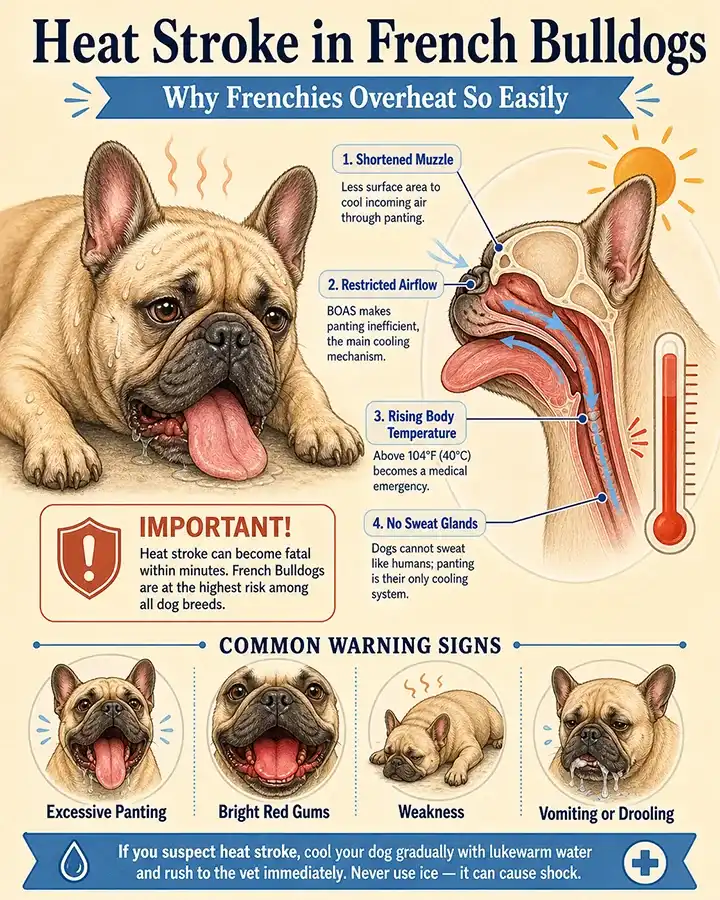
Dogs cool themselves by panting — moving hot air across moist tongue and lung surfaces. Frenchies have physically less surface area to do this, plus a windpipe that's often too narrow. Heat builds up fast and they can't get rid of it.
I. Why Frenchies Are 3-6× More Vulnerable
An excited Frenchie at 25°C feels the same heat stress as a Labrador at 35°C. The numbers, by breed:
- French Bulldogs: ~6× heat-stroke risk vs Labradors (Hall, O'Neill et al. 2020)
- English Bulldogs: 14×
- Pugs: 3×
- Heavy + over 2 years = highest-risk subgroup
- Overweight Frenchies have ~1.5× the risk of lean ones
II. Body Temperature Thresholds
| Zone | Temperature | What it means |
|---|---|---|
| Normal | 38.3-39.2°C / 101-102.5°F | Healthy at rest |
| Warning | 39.5-40°C / 103-104°F | Stop activity, cool |
| Heat stroke | ≥40.5°C / 105°F | Emergency — start cooling NOW |
| Critical | ≥41°C / 105.8°F | CNS dysfunction begins |
| Death zone | ≥43°C / 109.4°F | Mortality climbs sharply |
Time above 41°C kills — not just peak temp. Every minute matters.
III. Air Temperature — When Walks Become Dangerous
- Below 20°C / 68°F — safe
- 20-24°C / 68-75°F — caution; 10-15 min walks max
- 25-27°C / 77-81°F — risky; brief early-morning walks only
- 27°C+ / 81°F+ — DO NOT WALK
- Humidity above 80% — evaporative cooling fails entirely; treat 25°C + high humidity as a red zone
Place the back of your hand on the sidewalk and hold it for 7 seconds. If you can't, your Frenchie can't either. Hot pavement burns paws within 60 seconds at 52°C — and radiates heat up into your Frenchie's belly because of their low ground clearance.
IV. Warning Signs — Escalating
Early (act now)
- Heavy panting at rest
- Seeking cool surfaces (tile floors)
- Reluctance to move
- Drooling more than usual
- Bright pink tongue
Mid (emergency)
- "Freight-train" panting
- Thick, ropy saliva
- Very red gums or ears
- Glassy eyes
- Wobbling, won't respond to name
Severe (life-threatening)
- Dark red, purple, or grey gums; blue tongue (cyanosis)
- Collapse, vomiting, bloody diarrhea, seizures
- Body temperature ≥42°C / 107.6°F
- Unconsciousness
He was panting hard, I thought he was just tired. Five minutes later he was on the ground.
V. Cool First, Vet Second — Step-by-Step Response
Minute 0: Stop activity. Move to shade or A/C. Carry the dog — don't let them walk.
Minute 1-2: Get water on them. Cold water is correct and saves lives.
- Cold-water immersion (bathtub, kiddie pool, hose) — head OUT — for conscious, healthy Frenchies. Water 1-16°C is fine.
- Or continuous pour + fan — wet whole body, especially neck, chest, belly, paws.
Minute 3-10: Re-wet every 60 seconds. Aim for rectal temp 39.4°C / 103°F — then STOP cooling (rebound hypothermia risk).
Minute 10-15: Transport to vet with A/C on full + wet towels under (not over) the dog.
Always go even if your dog seems "recovered." Delayed-onset DIC (clotting failure) and kidney failure can hit 12-48 hours later.

"We learned the hard way that walking during the day wasn't an option. Year-round routine: 5:30 AM walk, indoor day with A/C set to 22°C, 8:30 PM walk. Tile floor in the bathroom is Spike's favorite spot. Power outage = emergency — we have a backup battery for the A/C."
VI. What NOT to Do
- Don't drive to the vet without cooling first — it's the #1 cause of death.
- Don't use only wet towels and leave them — they trap heat once warm (51% common mistake).
- Don't pour rubbing alcohol on paws — toxic + ineffective.
- Don't offer ice to chew or force water — vomit risk in a brachycephalic dog = aspiration pneumonia.
- Don't cover with wet blanket and close the car windows.
- The "tepid water only" myth is outdated — peer-reviewed cold-water immersion is now the gold standard.
Cooling Methods — Ranked by Speed
| Method | Speed | Best for |
|---|---|---|
| Cold-water immersion (1-16°C, head out) | Fastest | Conscious, healthy dogs |
| Evaporative (continuous pour + fan) | Fast | Senior, unconscious — works on any dog |
| Spraying with garden hose | Moderate | Backyard emergency |
| Wet towels alone | Slow | Only if rotated every 60 seconds |
| Ice packs (groin, neck, armpits) | Adjunct | Use WITH primary cooling, never alone |
VII. Daily Prevention
- A/C indoors at 22-24°C — never let your Frenchie live in a non-A/C room above 25°C.
- Walk windows: pre-dawn + post-sunset only in summer.
- Cooling mat (gel-based) on tile floor.
- Frozen Kong for indoor enrichment.
- Cooling vest (chamois, evaporative type) — soaked, two-finger fit.
- Pee pads or fake-grass patio for midday bathroom breaks.
- Multiple water bowls + ice in the car.
- Rectal thermometer + Vaseline in your dog kit.
- NEVER alone in a parked car (interior reaches 50°C in minutes).
- NEVER tied outside in the sun.
- Weight control — overweight Frenchies have 1.5× the risk.
VIII. Tropical & Humid Climates
Florida, Dominican Republic, southern Spain, Texas summer — these climates require an extra layer of vigilance. Humidity is the silent killer: 26°C with 90% humidity is more dangerous than 32°C with 30% humidity.
- A/C is medical equipment, not a luxury.
- Power outage = emergency (consider a generator or backup battery for A/C).
- Beach or pool: shade tent + fresh-water rinse mandatory.
- Pedialyte or coconut water in moderation during the hottest weeks (vet-approved).
The time-critical window
- UK ER mortality: 26.6% overall; 57% in severe cases; 3% in mild.
- Cold-water immersion to ≤38.8°C protocol = 100% survival in published reports.
- Golden window: first 30 minutes from collapse.
- After 60 min above 41°C = irreversible organ damage likely.
Owners Also Ask
Can I walk my Frenchie when it’s 25°C (77°F)?
Only briefly, and only early morning or after sunset. 25–27°C is the “risky” zone for a Frenchie; at 27°C+ don’t walk at all. And watch humidity — above 80% a dog’s evaporative cooling fails entirely, so 26°C with 90% humidity is more dangerous than 32°C dry. When in doubt, use the 7-second pavement test with the back of your hand.
Cold water or lukewarm water for an overheated dog?
Cold. The “tepid water only” advice is an outdated myth — peer-reviewed veterinary research now supports cold-water immersion (1–16°C, head out of the water) as the fastest safe method for a conscious dog, or continuous cold pouring plus a fan for any dog. Stop cooling at 39.4°C / 103°F rectal temperature. The full minute-by-minute protocol is in our heatstroke emergency guide.
My dog cooled down and seems fine. Do I still need the vet?
Yes — always, even if your Frenchie looks recovered. The most dangerous complications of heat stroke are delayed: clotting failure (DIC) and kidney failure can appear 12–48 hours after the event. The vet visit after cooling is not optional; it’s part of the treatment.
What are the first signs of heat stroke in a French Bulldog?
Early signs: heavy panting at rest, seeking cool tile floors, reluctance to move, extra drooling, bright pink tongue. It escalates to “freight-train” panting, thick ropy saliva, very red gums, and wobbling. Dark red, purple, or grey gums mean life-threatening — start cooling immediately and head to the ER.
Why are French Bulldogs so vulnerable to heat?
Dogs cool themselves by panting, and a Frenchie’s flat face gives them physically less surface area to do it — plus a windpipe that’s often too narrow (see BOAS). Research puts their heat-death risk at roughly 6× a Labrador’s. An excited Frenchie at 25°C feels the heat stress a Labrador would feel at 35°C.
References
- Hall, Carter, O'Neill — Scientific Reports 2020 — HRI Risk Factors. Nature.com
- Hall et al. — VetCompass HRI Clinical Grading Tool (Sci Reports 2021). PMC7994647
- RVC: "Cool First, Transport Second". RVC.ac.uk
- Cooling Methods UK Primary Care — Veterinary Sciences 2023. PMC10385239
- Pathophysiology of Heatstroke in Dogs — Bruchim et al. PMC5800390
- Cornell — Heatstroke Medical Emergency. Cornell.edu
- heatstroke.dog — Myth Busting Cooling. heatstroke.dog