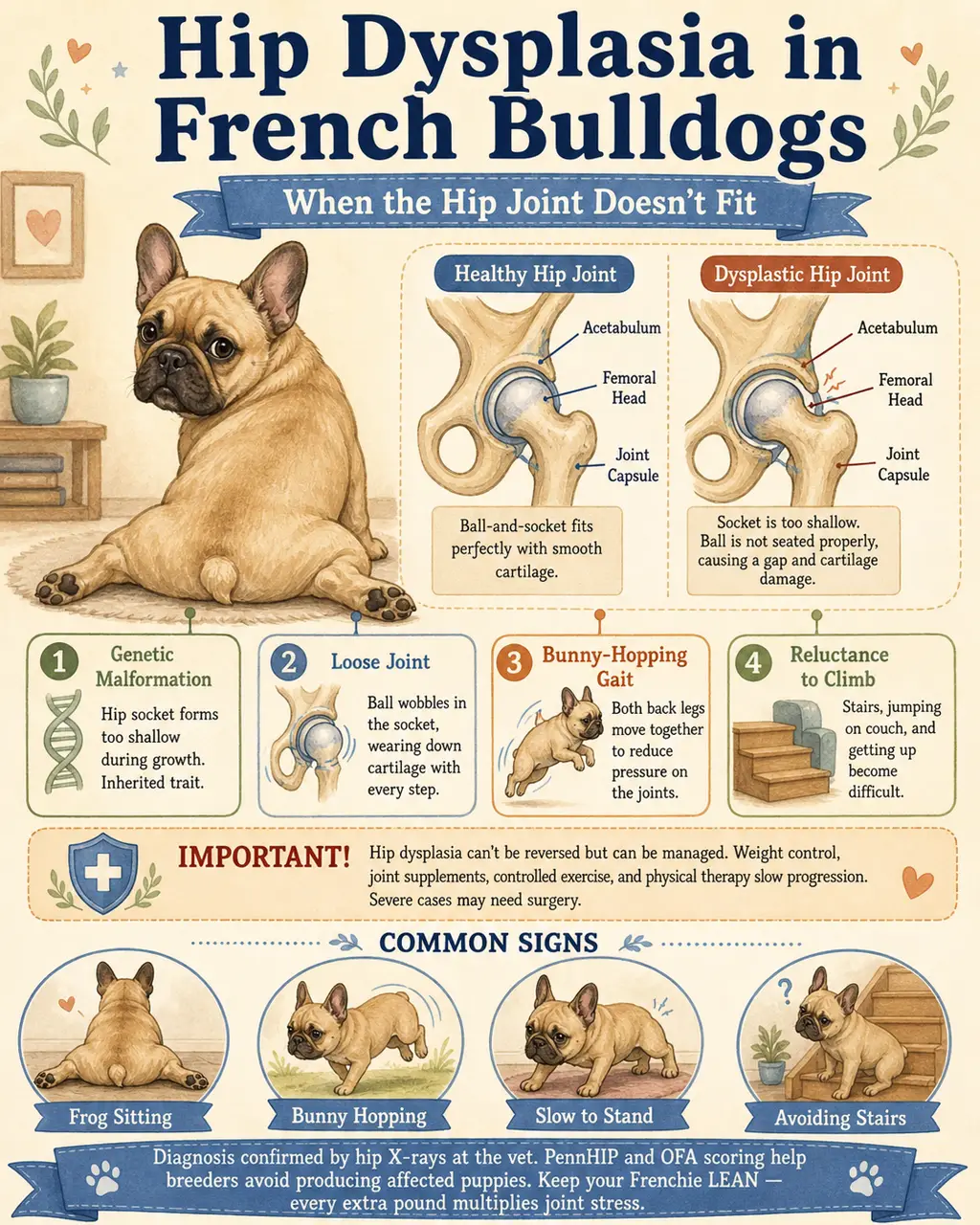
Bunny-hopping when running. Sitting with both back legs splayed out. Reluctant to take the stairs. Most Frenchie owners are told this is "just a Frenchie thing." It isn't. It's hip dysplasia — a hip joint that never formed correctly — and the breed hides it better than almost any other dog.
I. What Hip Dysplasia Is
Malformation of the hip joint where the ball of the femur doesn't fit properly into the pelvis socket. The result: a loose, unstable joint. Bone grinds bone, cartilage wears down, and the body's defensive response is painful arthritis.
It's a structural problem present from puppyhood that gets worse over time. Once the joint is malformed, you cannot undo it — you can only manage it.
II. Why Frenchies Are Prone
- Genetic predisposition — narrow gene pool from heavy line breeding.
- Chondrodystrophic skeleton — abnormal cartilage development hard-wired into the breed.
- Body shape — heavy top-loaded torso on short, splayed hind legs creates abnormal forces on the hip joint with every step.
III. What the OFA Database Shows
The Orthopedic Foundation for Animals (OFA) maintains the largest hip evaluation database in the world. The numbers for bulldog-family breeds are sobering:
- "Bulldog" entries: CHD prevalence as high as 77.7% — worst of any breed studied.
- In OFA’s hip statistics, Frenchies rank 25th of 220 breeds, counting from the worst-affected — 33.1% of the Frenchies evaluated had hip dysplasia.
- Average breed prevalence in OFA database: 15.56%.
- Frenchies sit far above this average.
Some dogs with major hip changes on X-rays may show no signs at all, while others with minimal changes may be in severe pain and limp. It often takes years of slow bone damage before a dog shows signs.
IV. Symptoms Owners Miss
- Bunny-hopping — using both hind legs together when running. The most classic sign.
- Frog sitting — one or both hind legs splayed to the side.
- Reluctance to climb stairs or jump.
- Lameness — limp on one or both hind legs after exercise or rest.
- "Belly dancer" hip sway when walking — pelvis shifts side to side.
- Decreased activity — stopping mid-walk, refusing play.
- Audible clicking sound from the hips.
- Muscle atrophy in hind legs as they stop using them.
- Pain when hips are touched.
Frenchies often hide pain. Bulldog-type breeds may have severe radiographic hip dysplasia but show minimal lameness because they're stoic, sedentary, and adapt their gait. Owners often miss it because the dog "doesn't seem in pain." But joint damage progresses silently.
V. How It Gets Diagnosed
- Standard X-rays — extended hip view, requires sedation for proper positioning.
- OFA scoring — Excellent / Good / Fair / Borderline / Mild / Moderate / Severe. Three board-certified radiologists evaluate, dog must be age 2+.
- PennHIP — measures distraction index (joint laxity), as early as 16 weeks. More predictive for breeding decisions.
VI. Treatment — Conservative vs Surgical
Conservative (most cases)
- Weight management — the single most important factor. Even a 10% weight loss produces dramatic improvement.
- Anti-inflammatory medication — vet-prescribed only, never human painkillers (they can cause kidney failure). Your vet chooses which one and the dose.
- Joint supplements — ask your vet first. In a 2022 review of 72 trials (69 in dogs), omega-3 (fish oil) eased arthritis pain, while glucosamine with chondroitin did not (Barbeau-Grégoire et al. 2022). The dose is your vet’s call. Start with a small amount and watch how he reacts — any dog can be allergic to anything, even fish.
- Joint injections — your vet decides whether they fit your dog.
- Physical therapy + hydrotherapy — underwater treadmill builds muscle without joint impact.
- Laser therapy and acupuncture as adjuncts.
Surgical options
- JPS (Juvenile Pubic Symphysiodesis) — only puppies under 20 weeks; fuses pelvis early to redirect hip socket growth.
- TPO (Triple Pelvic Osteotomy) — under 1 year; rotates hip socket.
- FHO (Femoral Head Ostectomy) — removes femoral head; muscle forms a "false joint." Best for dogs under 60 lbs (27 kg) with good muscle (Frenchies often qualify). Cost: $1,500–$3,000 per hip.
- THR (Total Hip Replacement) — gold standard for severe cases; replaces ball + socket with implants. $5,000–$7,000+ per hip.
VII. Lifelong Management That Works
Hip dysplasia is forever. Even after successful surgery, dogs still need:
- Weight control.
- Joint supplements, only if your vet recommends them.
- Low-impact exercise.
- Pain medicine from your vet during flare-ups.
Owner-recommended products
- Orthopedic memory foam beds — owners say they made a real difference.
- Pet ramps for couch, bed, and car.
- Toe Grips or non-slip socks for slippery floors.
- Pet-safe heated pads (low heat, auto shut-off) in winter — never a human heating pad left unattended; cold worsens stiffness.
- Joint supplements — only what your vet recommends (see Treatment above).
VIII. Common Owner Mistakes
- Mistaking a limp for "an injury that will heal."
- Dismissing bunny-hopping as "cute personality."
- Allowing weight gain — the biggest preventable mistake.
- Letting them jump off furniture.
- Starting supplements on your own — ask your vet which, if any.
- Over-exercising young Frenchies (forced jogging, long hikes).
References
- OFA Disease Statistics by Breed. OFA.org
- Demographics of Canine Hip Dysplasia US/Canada. PMC5366211
- VET4BULLDOG — Hip Dysplasia in Bulldogs/Frenchies. Vet4Bulldog.com
- VCA — Hip Dysplasia in Dogs. VCAhospitals.com
- AKC — Hip Dysplasia. AKC.org
- Barbeau-Grégoire M. et al. (2022). A 2022 Systematic Review and Meta-Analysis of Enriched Therapeutic Diets and Nutraceuticals in Canine and Feline Osteoarthritis. Int J Mol Sci. PMC9499673