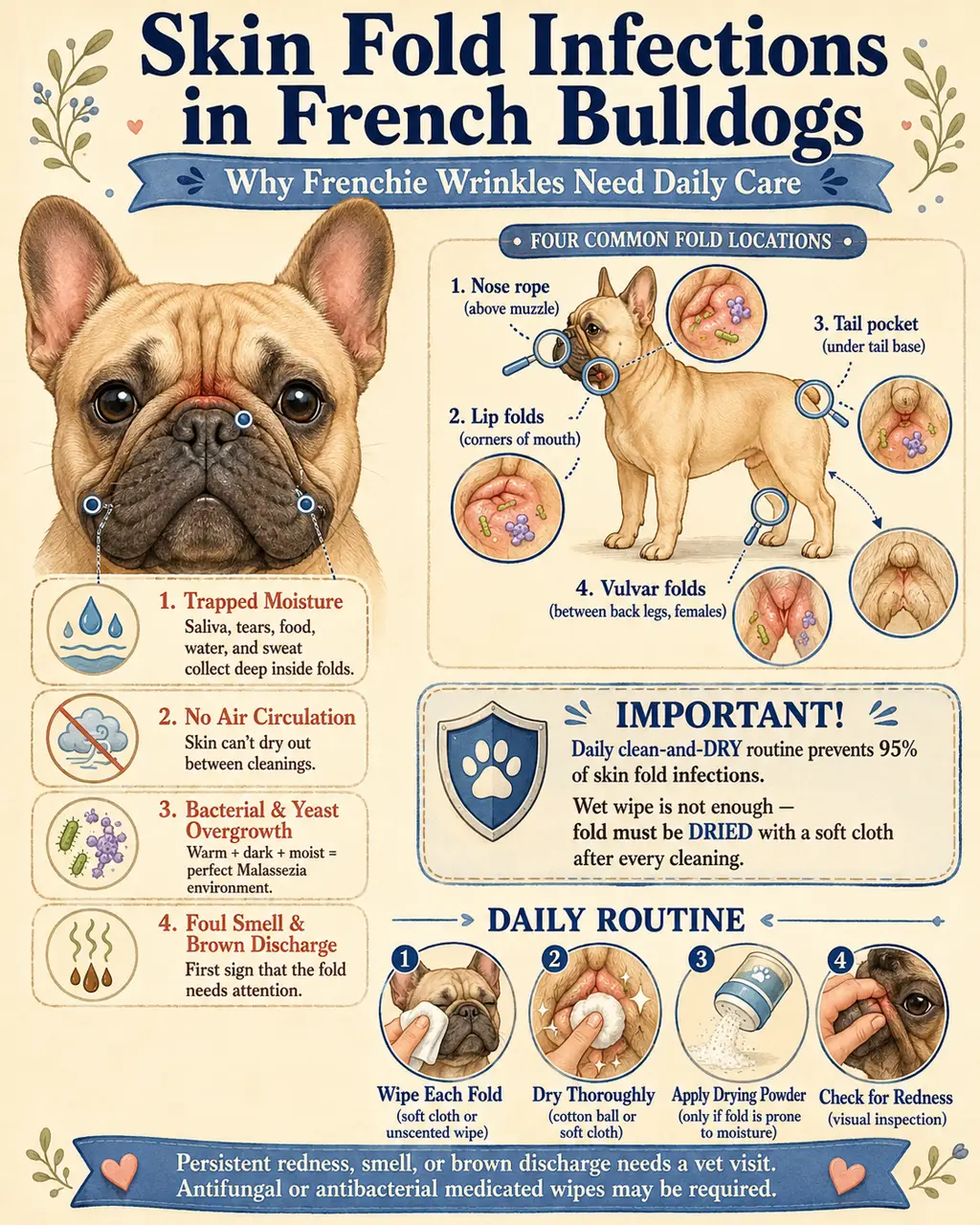
The wrinkles that make a Frenchie a Frenchie are also a year-round microclimate for bacteria and yeast. Most owners don't see the problem until it smells. By then it's already past prevention — and treatment means weeks of vet visits.
I. What Intertrigo Is
Intertrigo is an inflammation where two skin surfaces rub together inside a fold. Sweat and tears collect, oxygen stops circulating, and bacteria and yeast colonize the fold. Skin gets red, raw, smelly, and eventually loses hair.
In Frenchies most commonly: nose rope (muzzle wrinkle), tail pocket (dimple where tail tucks), and vulvar folds (females).
Not just cosmetic — left alone it can progress to a deep skin infection that needs antibiotics from your vet.
II. By the Numbers (VetCompass 2022)
| Breed | Odds ratio vs crossbred dogs |
|---|---|
| English Bulldog | 49.07× |
| French Bulldog | 25.92× |
| Pug | 16.27× |
III. Where Folds Get Infected
Distribution of cases across 123 Frenchies:
| Location | Cases | % |
|---|---|---|
| Facial (general or location not recorded) | 70 | 56.91% |
| Tail pocket | 14 | 11.38% |
| Vulvar folds (females) | 11 | 8.94% |
| Nasal fold specifically | 9 | 7.32% |
| Periocular (eye wrinkle) | 8 | 6.50% |
| Lips | 6 | 4.88% |
Face dominates — over half the cases. Tail pocket is #2 and the most forgotten by new owners.
IV. Symptoms to Spot Early
- Redness deep in the fold (you have to spread the fold to see it).
- Distinct sweet, sour, or musty smell.
- Dark brown or yellow waxy buildup.
- Hair loss along fold edges.
- Pyoderma (pus, crusting) in late stage.
- Dog rubbing face on furniture, scooting, licking.
V. Cleaning Routine
- Gauze and a fold cleaner your vet recommends — wipe deep into the fold.
- Wipe direction: 3 to 9 o'clock for the tail pocket, full sweep across the nose rope — keep the cleaner well away from his eyes.
- DRY COMPLETELY — this is the step owners skip. Trapped moisture is worse than no cleaning at all.
- Folds that stay damp: ask your vet about a drying powder.
- Frequency: 2–3 times a week if healthy (the tail pocket once a week); during an infection, as often as your vet says.
Wet wipes "clean" but they leave moisture behind. A wet fold in a closed environment creates ideal conditions for yeast and bacteria. If you don't have time to dry, don't clean.
VI. The Tail Pocket
Many first-time owners don't know the tail pocket exists.
How to clean the tail pocket
- Lift the tail gently.
- Rolled gauze with the cleaner your vet recommends.
- Reach all the way under the tailbone.
- Dry with clean tissue.

"Caribbean humidity means folds don't dry on their own — ever. Spike's nose rope and tail pocket get wiped and dried every evening. 30 seconds. We learned the hard way that skipping a week meant a vet visit and a course of antibiotics."
VII. Which Products
- Ask your vet which wipes or fold cleaner to use — medicated wipes contain medicine, and the right one depends on what is growing in the fold.
VIII. When to Vet
- Visible pus or yellow crusting.
- Bleeding when touched.
- Bad smell that won't clear with cleaning.
- Hair loss spreading beyond the fold.
- Dog flinching or yelping when touched.
Vet treatments include prescription creams, antibiotics for deep infections, or nose-rope removal surgery (rhytidectomy) in extreme cases.
Prevention takes 30 seconds, 2–3 times a week. Treatment means weeks of vet visits. Intertrigo usually needs lifelong care — surgery to remove the fold is an option only in severe cases.
IX. Common Owner Mistakes
- Not knowing the tail pocket exists.
- Never clean a fold without drying it.
- Never use human wet wipes (they irritate the skin).
- Never use alcohol or peroxide on the folds.
- Never let the infection get to bleeding or pus before acting.
- Never stop the routine once the fold looks healed (the infection will come back).
References
- Ironing Out the Wrinkles — Nature Sci Reports 2022. nature.com
- VetCompass PMC version. PMC9259571
- RVC VetCompass press release. rvc.ac.uk
- Brachycephalic Dermatology Review. PMC10294810
- French Bulldog Tail Pocket FAQ. frenchbulldognews.com