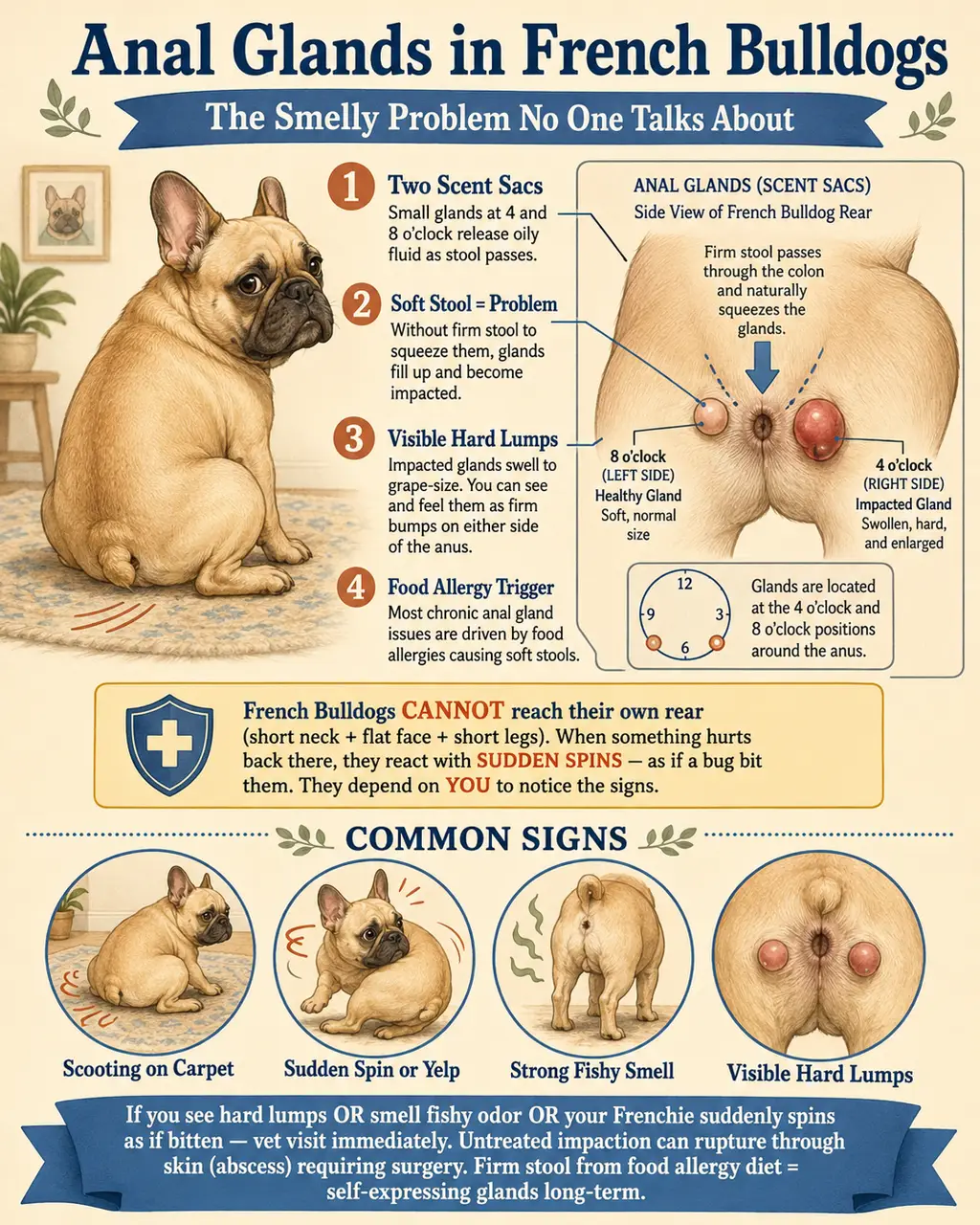
Scooting on the carpet. A strong fishy smell that lingers on the bedding. The dog suddenly sits down and looks back at his own butt. These aren't quirks — they're anal glands. And in Frenchies, the cycle is almost always driven by something further upstream.
I. What Anal Glands Are
Two pea-sized scent sacs at 4 and 8 o'clock of the anus, just inside the anal sphincter. They produce a thick, oily, foul-smelling secretion that normally empties through tiny ducts when the dog poops — firm stool presses against the sacs and squeezes them.
Originally a territorial-marking and scent-ID system. Modern dogs don't really need them.
II. Why Frenchies Are Prone
O'Neill et al. 2021 VetCompass (n=104,212 UK dogs):
- Anal sac disorder (ASD) 1-year prevalence: 4.40%
- Brachycephalic = 2.62× odds vs dolichocephalic (long-nosed)
French Bulldog VetCompass 2021:
- Anal sac impaction: 4.5% (OR 1.27, 95% CI 1.03–1.55)
- Any anal sac disorder: 5.1% (OR 1.31, 95% CI 1.08–1.58)
Why the predisposition
- Small ducts — relatively small anal sac ducts are one known contributing factor.
- Soft stool — one possible factor: firm stool helps the sacs empty, though studies do not find it in every dog. Frenchies have about 7× the odds of a food allergy diagnosis compared with other dogs (VetCompass 2021: 1.9% vs 0.3% a year), and a food allergy can mean soft stool.
FORUM FINDING (frenchbulldognews.com forums) — UNOFFICIAL FINDING: multiple owners report quarterly expression visits dropping to zero after diet correction.
III. The Four Kinds of Trouble
| Problem | Description |
|---|---|
| Impaction | Sacs full but not infected — most common |
| Sacculitis (inflammation) | Inflamed, sometimes infected, painful |
| Abscess | Infected, ruptured or about-to-rupture |
| Tumor (apocrine adenocarcinoma) | Older dogs, firm mass, sometimes high blood calcium |
Recurrence rates vary widely between studies and clinical experience — ask your vet about specific risk for your dog.
IV. The Symptoms Owners Recognize
- Scooting — dragging the rear across carpet or grass.
- Excessive licking or chewing at the rear (ironic, since most Frenchies can't really reach).
- Strong fishy or metallic smell that lingers on bedding.
- Sudden sitting and looking back.
- Reluctance to sit, sitting awkwardly.
- Abscess: visible swelling, redness, hot to the touch, blood or pus on bedding, fever.
V. Manual Expression — Vet, Groomer, and Why Not DIY
Vet (internal expression)
- The vet inserts a finger into the rectum.
- The gland is squeezed between thumb and finger.
- This empties the sac completely.
Groomer (external expression)
- The groomer squeezes the glands through the skin from outside.
- This does not always empty the sac completely.
DIY
- DIY only after your own vet has taught you how.
- Routine non-medical expression should NOT be done on dogs that don't need it.
- Our opinion: express only when he has symptoms, and let your vet decide.
Allergies (environmental or food) are the most common problem found alongside anal sac inflammation, and treating them may help prevent flare-ups — ask your vet about an allergy work-up.
VI. Frequency — How Often
- How often varies from dog to dog — your vet decides.
- Some dogs go years without intervention.
- Some need monthly.
- If your dog needs more often → address the underlying cause (allergies, soft stool, weight).
VII. Diet & Prevention — The Highest Leverage
One of the most useful steps: firm, bulky stool (Whole Dog Journal). It helps the sacs empty, though a veterinary review found stool quality is not a consistent factor in every dog.
- More fiber — ask your vet first — for example plain canned pumpkin (never pie filling) or plain, unflavored psyllium husk (flavored or sugar-free versions can contain xylitol, which is toxic to dogs). Nothing extra goes in the bowl because you decided it should: your vet says what and how much.
- Check for an allergy — allergies (environmental or food) are the most common problem found alongside anal sac inflammation; ask your vet about an allergy work-up. Treating the allergy may help prevent flare-ups.
- Weight — keep him lean; obesity is listed as a possible risk factor, though a large UK study found no link.

"Our opinion, from Igor: before you settle into a lifetime of expressions, ask the vet about allergies. They are the most common problem found alongside anal sac inflammation, and treating them may help the glands too."
VIII. Surgery for Chronic Cases — Anal Sacculectomy
Reserved for persistent, painful, recurrent disease. Less than 1% of UK ASD cases per VetCompass.
- Overall complication rate: ~32%.
- Problems passing stool, including temporary incontinence: about 15% — most resolved by the time the stitches came out.
- Permanent fecal incontinence: rare with good technique (0% in published series of 62 closed bilateral procedures).
- Smaller dogs <15 kg (33 lb) (most Frenchies) had more complications in one study (62 dogs) → choose a surgeon with breed-specific experience.
IX. Common Owner Mistakes
- It is NOT "just worms." Scooting is usually the anal glands, not worms.
- ALWAYS watch for the signs, even if he seems fine. An untreated impaction can turn into a painful abscess.
- NO routine "just because" expressions — only if he has symptoms, and your vet decides (our opinion).
- Work on soft stool with your vet — it is one possible factor. The long game is firm stool and treating any allergy, not more frequent expressions.
- Do NOT attempt DIY expression without vet training. Wrong-direction pressure can rupture the duct.
References
- O'Neill et al. — Non-neoplastic anal sac disorders UK dogs. PubMed 33645764
- VetCompass Frenchies study. PMC8675495
- RVC VetCompass — anal sac disorders. RVC.ac.uk
- Whole Dog Journal — Dog Scooting. Whole-Dog-Journal.com
- Whole Dog Journal — Food + Anal Glands. Whole-Dog-Journal.com
- Anal Sacculectomy Complication Rates. CliniciansBrief.com
- Today's Veterinary Practice — Canine Anal Sacculitis. TodaysVeterinaryPractice.com