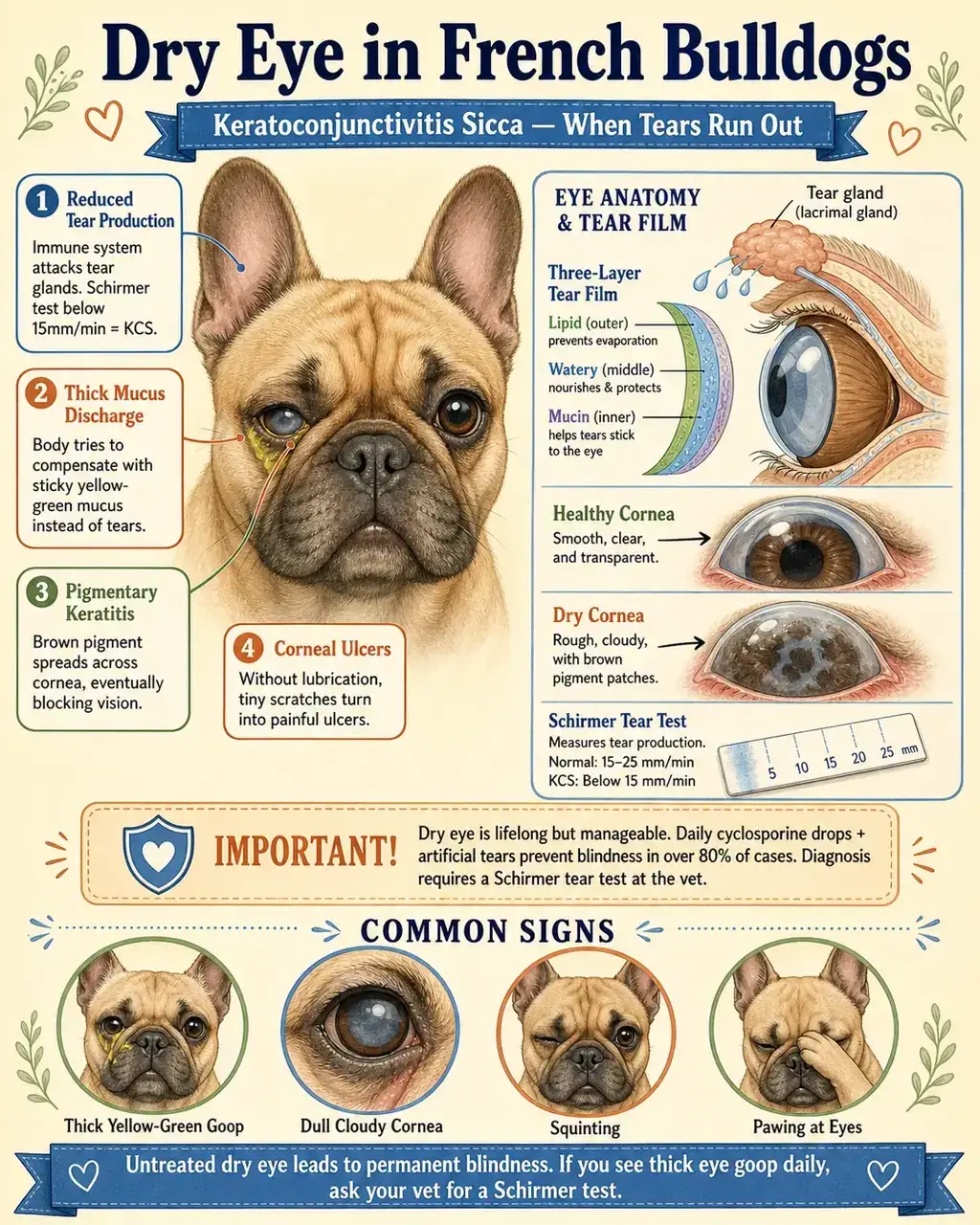
Thick yellow or green gunk in your Frenchie's eye corner? Eye looks dull, not shiny? Lots of squinting? It's not "just an eye infection." It's KCS — your Frenchie's eye isn't making enough tears. Without treatment: blindness. With treatment, most dogs stay comfortable.
I. What It Is
KCS = "dry eye." The eye doesn't produce enough tears to keep the cornea lubricated. Tears wash debris, deliver oxygen and nutrients, and contain antimicrobial proteins. Without them: the cornea dries, inflames, develops thick yellow-green mucus (the eye compensates with mucus instead of water), and eventually scars, pigments, ulcerates, or perforates.
KCS = the eye doesn't produce enough tears. Without tears, the cornea dries, inflames, and develops thick mucus. Untreated → corneal scarring, pigment, ulcers, perforation, blindness. Diagnosis: Schirmer Tear Test (paper strip, 60 seconds, painless). Treatment: cyclosporine (Optimmune) — lifelong. Your vet sets the schedule.
II. Two Functional Types
- Quantitative KCS — not enough tear volume (diagnosed with the Schirmer test)
- Qualitative / evaporative KCS — enough volume but tears evaporate too fast (in one study of 809 French Bulldogs, 28.8% had this type — more than the 16.2% with too little tear volume)
III. Why Frenchies Are Prone
- Genetic — autoimmune destruction of lacrimal glands (most common cause overall)
- Brachycephalic anatomy — wide eye openings + incomplete blink (lagophthalmos) = tears evaporate before spreading
- Iatrogenic (vet-caused) — gland excision after cherry eye dramatically increases KCS risk (in 3 small studies, between 1 in 8 and about 7 in 10 eyes developed dry eye after the gland was removed)
IV. Symptoms
- Thick yellow, green, sticky mucus in the inner corner (NOT clear watery tears)
- Persistent redness (conjunctivitis "won't go away")
- Squinting, blinking, pawing at the eye
- Dull / lackluster cornea (loses its shine)
- Recurrent corneal ulcers
- Pigmentary keratitis (brown spots developing)
- Severe cases: blindness from chronic ulceration + scarring
V. The Schirmer Tear Test (STT)
- Paper strip placed under the lower eyelid for 60 seconds
- Normal: >15 mm/min wetted
- KCS: <10 mm/min together with typical signs; under 5 mm/min is certain
- Borderline: 10-15 mm/min
- Cheap, fast, painless
- Every Frenchie should have this annually
Note: healthy Frenchies actually have higher Schirmer values (about 19 mm/min) than dogs with longer noses (about 17 mm/min) — STT alone can miss evaporative dry eye, which healthy Frenchies as a group show signs of (Frontiers 2025).
VI. Treatment
All KCS medications must be prescribed by your veterinarian. Do not use over-the-counter human eye products on your dog.
Cyclosporine (Optimmune) — first-line lifelong
- FDA-approved for canine KCS
- Suppresses immune-mediated lacrimal gland destruction
- About 8 in 10 dogs respond when some tear production remains; about half when the eye is almost completely dry
- Your vet rechecks after about a month; it can take up to 12 weeks to know if it works
Tacrolimus (compounded)
- Used when cyclosporine fails — your vet or eye specialist decides
- More potent than cyclosporine
- In the main published trial, it helped about half of the eyes that had not responded to cyclosporine (Berdoulay et al. 2005)
- Made to order by a compounding pharmacy
Adjuncts
- Artificial tears, on top of the prescription — which ones and how often, your vet decides
- Pilocarpine (oral) — rarely used, for neurogenic (nerve-related) KCS; only if your vet decides
- Antibiotic drops during flare-ups — only on your vet’s prescription
- Parotid duct transposition (surgery, last resort) — redirects salivary gland to lubricate the eye
VII. Lifelong Management
KCS is NOT curable, only controllable. KCS needs treatment for life — stopping the drops lets it come back. How often, your vet decides.
Without Treatment
- Progressive corneal scarring
- Pigmentary keratitis
- Recurrent ulcers
- Corneal perforation
- Blindness + possible enucleation (eye removal)
VIII. Often Missed Until Corneal Damage
KCS often looks like a simple eye infection at first. If the discharge keeps coming back, ask your vet for a Schirmer tear test — the later KCS is found, the more likely the cornea is already pigmented or scarred.
Our opinion: If your Frenchie has chronic green discharge — demand a Schirmer test.
References
- Frontiers in Vet Science 2025 — Tear film in French Bulldogs. FrontiersIn.org
- Cornell — KCS in Dogs. Cornell.edu
- Immune-mediated KCS Management. PMC6067592
- Today's Veterinary Practice — Diagnosis & Treatment KCS. TodaysVeterinaryPractice.com
- Brachycephalic Ocular Syndrome (Today's Veterinary Practice). TodaysVeterinaryPractice.com
- VET4BULLDOG — Bulldog/Frenchie Dry Eye. Vet4Bulldog.com