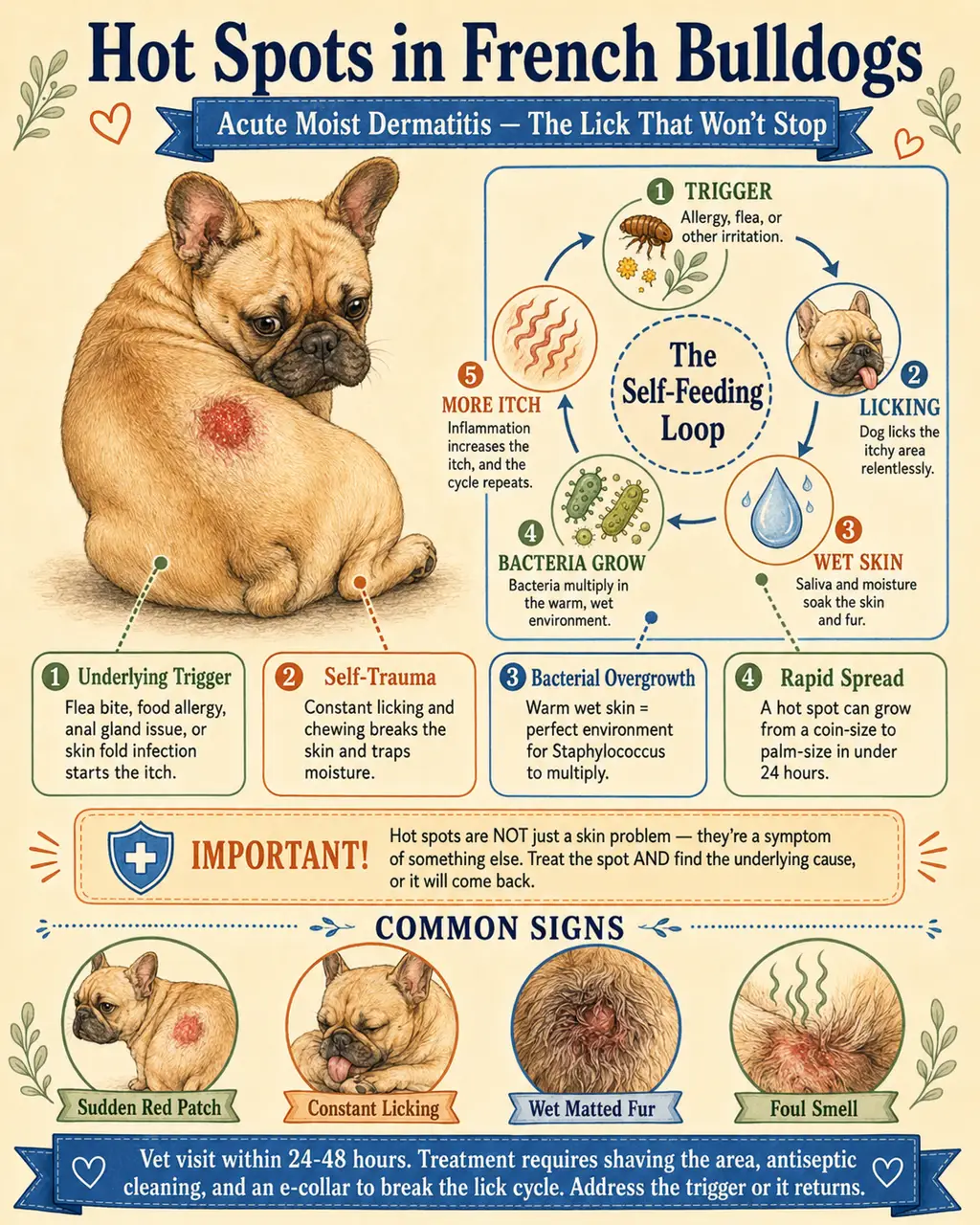
A hot spot can go from a pinpoint red spot in the morning to a raw patch the size of a pancake by evening (VCA). The first hours are everything. Cone is non-negotiable.
I. What a Hot Spot Is
A sudden, raw, oozing patch of inflamed skin appearing in hours. It's a self-trauma injury — dog itches, licks, breaks the skin, infection sets in, more itching, more licking. A positive feedback loop.
Veterinary literature: pyotraumatic dermatitis — a surface infection on skin the dog has injured himself.
II. How Fast They Spread
This is the key fact owners under-rate. VCA describes hot spots that can grow from pinpoint redness to "the size of a pancake" between morning and evening; Cornell adds that a sore older than 24 hours is likely infected and needs the vet.
III. Triggers in Frenchies
- Allergies (atopic, food, contact) — one of the two main causes, with fleas (Cornell). Frenchies have about twice the odds of atopic dermatitis (VetCompass 2021).
- Flea bites — especially in flea-allergic dogs (VCA, Cornell).
- Anal gland issues — impacted/infected glands → licking around the rump → tail-base hot spots.
- Trapped moisture — after swim, bath, rain (especially behind ears, under collar).
- Insect bites — mosquito, ant, spider.
- Clipper rash from grooming.
IV. Why Frenchies Are More Prone
- Skin fold microclimates harbor bacteria.
- Allergy predisposition lowers reactive itching threshold.
- Anal gland anatomy in brachycephalic dogs tends toward problems.
- Stocky body shape — moisture pools in armpits, groin, neck folds.
V. Owner First Response — Do It Now
- CLIP THE HAIR on and around the hot spot with electric clippers (NOT scissors — too risky). Non-negotiable. Hair traps moisture and bacteria. If he flinches, cries, or snaps, stop and let the vet do it (VCA: he may need sedation).
- CLEAN with saline. Gently dab — don't scrub.
- DRY COMPLETELY with clean gauze.
- CALL YOUR VET and ask what to put on it — see the vet — a sore older than 24 hours is likely infected (Cornell), even if it looks better.
- PUT THE CONE (E-COLLAR) ON HIM IMMEDIATELY. Licking undoes healing fast (UNOFFICIAL FINDING from owners: within about 30 minutes).
- PHOTOGRAPH to track 24-hour change.

"In tropical heat the moisture trap is constant. We dry Spike completely after every walk — behind the ears, under the collar, between the toes. The cone lives near the door, not in a closet. The 30 seconds you save by skipping it costs you a week."
VI. Topical Treatments
- What to put on it — antiseptic sprays, anti-itch sprays and prescription creams all exist; which one is safe for his skin, how often and for how long is your vet’s call.
- Manuka honey — FORUM FINDING (owner forums) — UNOFFICIAL FINDING: owners say it is antibacterial and helps healing. Studies in dogs are mixed and none we found is on hot spots; in a 2024 controlled trial on incisional wounds (Gouletsou et al.) it showed no significant cosmetic advantage. Ask your vet before you put anything on a hot spot.
VII. When Systemic Antibiotics Are Needed
Go to the vet the same day if:
- The sore is getting bigger.
- Yellow pus or thick crusting (pyoderma).
- Fever or lethargy.
- Spread to multiple sites.
- It is older than 24 hours (Cornell).
- Located near eye, ear canal, or genitals.
Never give antibiotics or steroids without veterinary prescription. Typical treatment: an oral antibiotic plus topical care, and in severe cases a short course of anti-itch medicine — which one, how much and for how long is your vet’s call.
VIII. Prevention & Owner Consensus
Prevention
- Year-round flea protection — non-negotiable for Frenchies; your vet chooses the product.
- Dry the dog thoroughly after baths and swims (behind ears, under collar, in folds).
- Anal glands checked — by your vet if he’s scooting; how often, your vet decides.
- Manage allergies with your vet — medicine or a hypoallergenic diet trial.
- Remove collar when home so the neck stays dry.
- Check daily during summer / humid months.
The short version
- Speed of response = damage limitation. Hours matter.
- Cone is non-optional. Skip it = regret. VCA lists an E-collar or bandage to stop licking as part of treatment.
- Hot spots are usually a symptom of something else (flea allergy, atopy, anal glands). Treating the spot without finding the root cause means it comes back. VCA lists allergies, insect bites, ear and skin infections and anal gland inflammation among the causes, and says to treat the underlying cause.
References
- Hot Spots — Cornell Riney Canine Health Center. cornell.edu
- Hot Spots in Dogs — VCA Hospitals. vcahospitals.com
- First Aid for Hot Spots — VCA. vcahospitals.com
- Hot Spots in Bulldogs — VET4BULLDOG. vet4bulldog.com
- Hot Spots on Dogs — PetMD. petmd.com
- Gouletsou et al. First-Intention Incisional Wound Healing in Dogs and Cats: A Controlled Trial of Dermapliq and Manuka Honey. Veterinary Sciences, 2024. PMC10892332