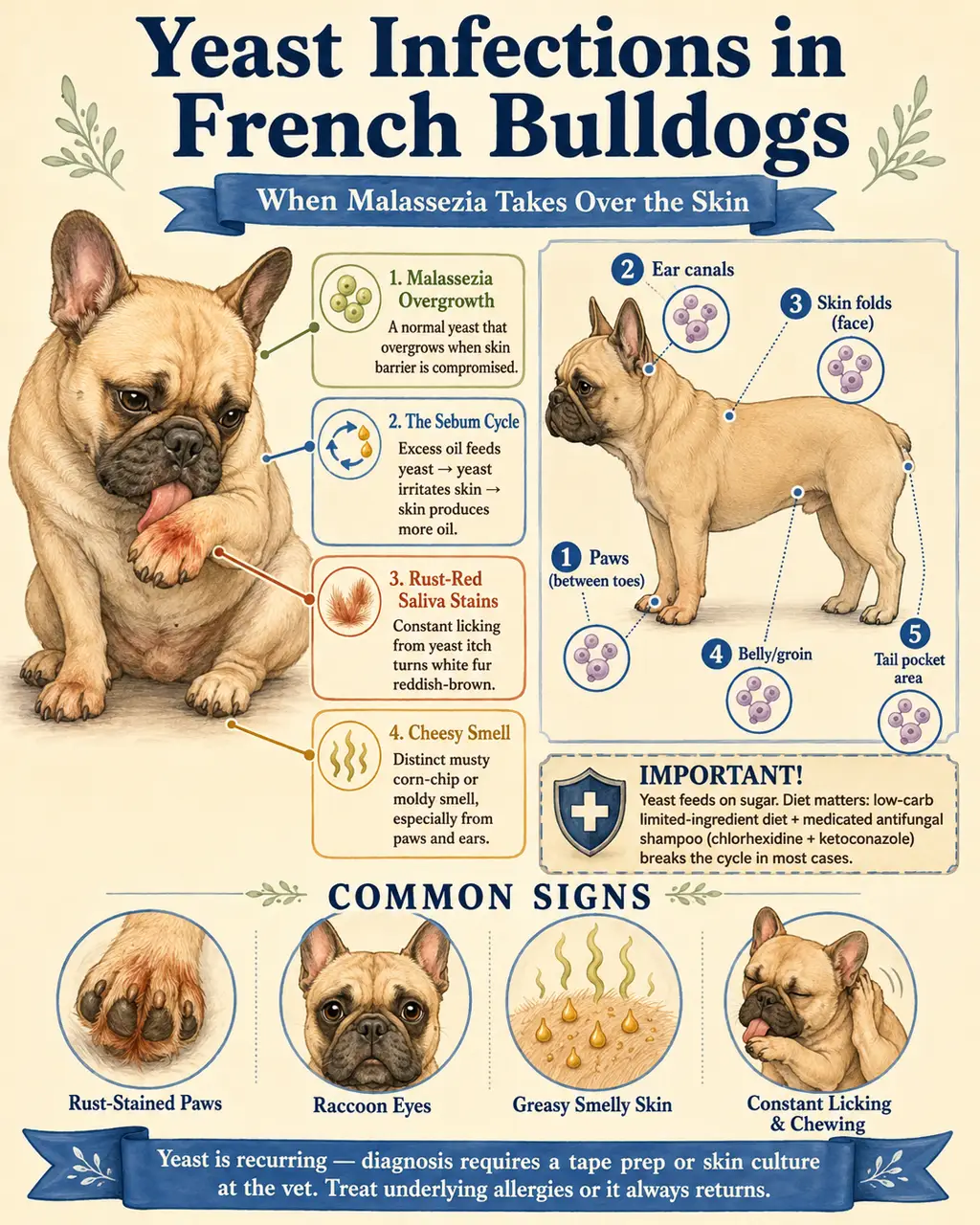
If your Frenchie smells like a corn-chip bag and has rust-colored paws even after a bath, you're probably not dealing with allergies alone. That combination points to yeast on top of another skin problem, and steroids alone do not treat it.
I. What Yeast Infection Is
Malassezia pachydermatis lives normally on every dog's skin in small numbers. The problem starts when something disrupts the skin barrier — allergies, moisture, antibiotics — and the yeast multiplies out of control.
Oily skin feeds yeast, and the skin problems behind it (allergies, seborrhea) keep it going until they are treated. In flat-faced dogs like Frenchies, skin folds and allergies favor yeast, and it keeps coming back until the underlying cause is managed.
II. Why Frenchies Are Prone
- Skin folds trap moisture and warmth (face, neck, tail pocket, vulva). Warm, damp folds are the conditions in which yeast overgrows.
- Brachycephalic biology — elevated rates of atopic and food allergies. The 2023 review (PMC10294810) found Frenchies, Boxers, Pugs, and Shih Tzus all show increased allergy risk.
- Tight toe spacing on stocky paws — less airflow between toes, the classic "frito feet" smell.
III. Symptoms to Recognize
- Rust-colored paws (saliva staining from licking).
- "Raccoon eyes" — dark crusty eye-wrinkle buildup.
- Frito-feet / corn-chip smell.
- Recurrent ear infections (brown waxy discharge).
- Red belly, armpits, groin.
- Hyperpigmentation (gray or black "elephant skin").
- Greasy coat (oily even after a bath).
IV. Yeast vs Allergy — How to Tell
- Allergy alone: red, itchy skin; the vet's skin sample shows no yeast overgrowth.
- Yeast: smelly, greasy, dark patches; the skin sample shows yeast. It usually comes on top of another problem, most often allergies (Can Vet J 2017).
- Both together: itchy + smelly + greasy + rust paws.
Owner mistake: treating only the itch with steroids. Steroids alone calm the itch but do not treat yeast, and long courses make yeast infections more likely (VCA; Can Vet J).
V. What Feeds Yeast — The Diet Question
FORUM FINDING (Reddit, Frenchie forums) — UNOFFICIAL FINDING: owners report visible improvement in 2–4 weeks after cutting sugars, simple carbs, sweet potato, peas, and white rice.
Official sources do not confirm it. No veterinary source we opened lists cutting sugar or carbohydrates as a treatment for Malassezia dermatitis. In the lab, Malassezia pachydermatis could not use glucose as its only source of carbon; it depends on lipids, the oils of the skin (Puig et al., PLoS ONE, 2017).
What is documented: a food allergy underneath. Yeast overgrowth is often secondary to another problem. The Merck Veterinary Manual notes that secondary infections with Staphylococcus or Malassezia are common in food-allergic animals. When food is the trigger, the standard way to find out is an elimination diet trial: a novel-protein or hydrolyzed food, fed exclusively, for at least 8–10 weeks (VCA; Merck Veterinary Manual).
How: set it up with your vet. The dog eats only the trial food for the whole trial, and if the skin is infected the vet may treat that first. Weeks spent on a trial that was not run properly are weeks the real cause keeps going.
VI. Topical Treatments With Your Vet
- A medicated shampoo — which one, how long to leave it on, and how often: your vet’s call.
- Medicated wipes for folds and paws — ask your vet which ones and how often.
- Apple cider vinegar paw soak — disputed, never on raw or broken skin. FORUM FINDING (owner forums) — UNOFFICIAL FINDING: owners report using it. WEBSITE FINDING (Whole Dog Journal) — UNOFFICIAL FINDING: the magazine disputes it. Ask your vet before trying it, and start with one paw.
- Coconut oil — disputed, ask your vet first. This yeast lives on fats, and no study we opened shows coconut oil helps.

"Tropical humidity is yeast heaven. We wipe his paws every evening after the walk and, only when he has an infection and his vet prescribes it, give him a medicated bath once a week. The smell took two months to leave. The rust on his paws? Six. Patience is the whole game."
VII. Systemic Treatment — Vet Only
Oral antifungals are prescribed and dosed only by your vet, based on your dog's weight, liver and kidney function, and other medications. Oral antifungals can harm the liver, and for longer courses your vet may check blood tests.
- There are several oral antifungals and protocols (including pulse protocols) — which one, how much, and for how long is decided only by your vet.
VIII. Timeline — What to Expect
- Week 1: the itch usually eases once treatment starts (VCA).
- Week 3–4: your vet usually rechecks with a new skin sample (Can Vet J 2017).
- After that: how long treatment lasts, your vet decides.
- Our opinion: rust paw staining takes months to grow out (it has to grow out — staining doesn't bleach).
IX. Common Owner Mistakes
- Over-bathing — use medicated shampoo only as often as your vet says.
- Long-term steroids — mask symptoms, feed yeast.
- Stopping treatment too early — yeast often comes back soon after.
- NEVER use human anti-dandruff shampoo — ask your vet for a dog shampoo.
Owners Also Ask
Why does my French Bulldog smell like corn chips?
A “Frito feet” smell comes from the ordinary bacteria and yeast that live on every dog’s skin, Malassezia among them. Frenchie paws — stocky, with tight toe spacing and little airflow — stay warm and damp, the conditions in which yeast overgrows. Smell alone does not diagnose anything. What points to overgrowth is a strong, persistent smell together with rust-colored paws, a greasy coat, or constant licking, and your vet confirms it by looking at a sample under the microscope.
How do I know if it’s yeast or allergies?
Allergy alone: red, itchy skin. Yeast: the smell, greasy coat, dark “elephant skin” patches. Yeast usually comes on top of another problem, most often allergies. Your vet confirms it with a quick skin sample (a piece of tape and a microscope) together with the exam.
How long until the smell and rust stains go away?
Longer than anyone wants to hear. With consistent treatment, the itch usually eases within a week (VCA), and your vet usually rechecks after 3–4 weeks with a new skin sample; how long treatment lasts, your vet decides. Every dog is different — if it is not improving, go back to your vet. Our opinion: the rust staining on paws takes months — it doesn’t wash or bleach out, the stained hair has to grow out. Patience is the whole game.
Can I treat a yeast infection at home?
Only together with your vet. Your vet decides which medicated shampoo and wipes to use and how often, and oral antifungals are strictly vet-territory — they can harm the liver. And skip the steroid shortcut: steroids alone calm the itch but do not treat yeast.
Does a “yeast-free diet” actually work?
FORUM FINDING (Reddit, Frenchie forums) — UNOFFICIAL FINDING: owners report visible improvement in 2–4 weeks after cutting sugars and simple carbs. Official sources do not confirm it: no veterinary source we opened lists cutting sugar as a treatment, and in the lab this yeast could not use glucose as its only source of carbon; it depends on the oils of the skin. What is documented: when a food allergy sits underneath, an elimination diet trial (a novel-protein or hydrolyzed food, fed exclusively for at least 8–10 weeks) is the standard way to find out, and secondary yeast infections are common in food-allergic animals. Set it up with your vet, because a food trial only answers the question if it is run properly.
References
- Canine Malassezia dermatitis. PMC5603939
- Malassezia in Veterinary Dermatology. PMC7059102
- Brachycephalic Dermatology Review. PMC10294810
- Puig et al. Characterization of the species Malassezia pachydermatis and re-evaluation of its lipid dependence using a synthetic agar medium. PLoS ONE, 2017. PMC5460872
- Cutaneous Food Allergy in Animals — Merck Veterinary Manual. merckvetmanual.com
- Implementing an Elimination-Challenge Diet Trial (Dog) — VCA Hospitals. vcahospitals.com
- Yeast Dermatitis — VCA Hospitals. vcahospitals.com