When should I switch my French Bulldog from puppy food to adult food?
Most Frenchies finish growing somewhere between ten and twelve months, and that is usually when the switch to adult food happens — but the trigger is that growth has finished, not that a birthday passed. Your vet confirms it. Change the food over seven to ten days, replacing a little more of the old food each day; an abrupt switch causes stomach trouble that then gets blamed on the new food. Do not switch early because he looks big, and do not add vitamins or minerals to a growing puppy’s bowl on your own — a complete food already has them balanced against each other.
The ten rules
This is the whole method. Read further only where you want to know why.
- Feed a puppy a growth food, not adult food in a smaller portion
- Do not add vitamins or minerals on your own
- Switch to adult food when growth is finished, not on a birthday
- Change the food over seven to ten days
- Watch the adult years — that is when the weight arrives
- After neutering, ask your vet about the food
- Weigh him now and then, and write it down
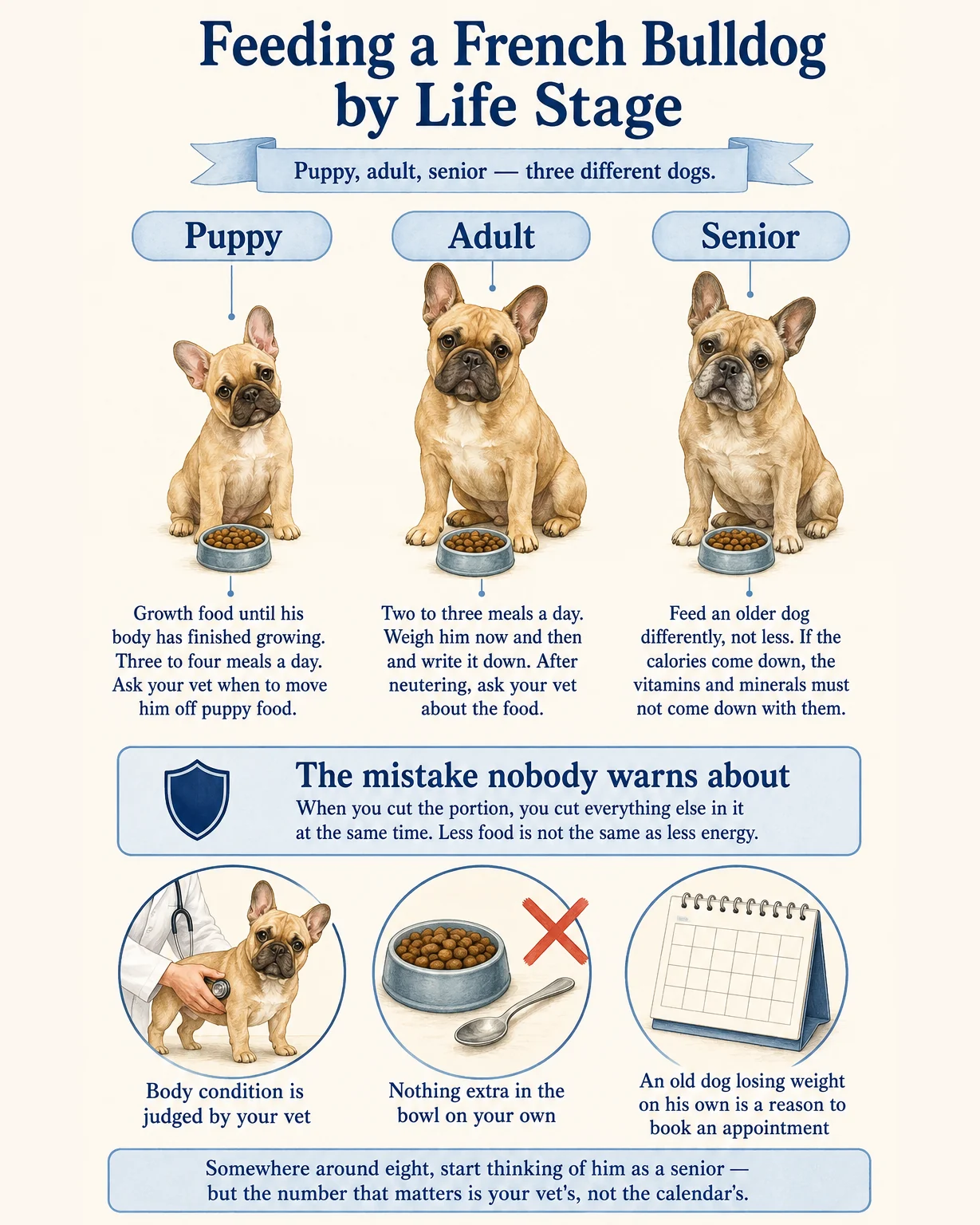
- Feed an older dog differently, not less
- If a senior eats less, check his mouth first
- Keep the habits that do not change with age
1 Feed a puppy a growth food, not adult food in a smaller portion
Growth food is not adult food in a smaller bag. It is a different balance — protein, calories, vitamins and minerals, and the ratio between them — formulated for a skeleton that is still being built. Feeding an adult maintenance food to a growing puppy is not thrift, it is a gap.
- Meals — 3 to 4 a day while young, settling to 2 or 3.
- Food — one labeled for growth, ideally backed by AAFCO feeding trials (AAFCO is the U.S. organization that sets pet food standards) rather than formulation alone. How to read the bag →
- Condition — a puppy should be lean. A round puppy is an overweight puppy, and early excess weight is not something they simply grow out of.
2 Do not add vitamins or minerals on your own
A food labeled complete is already balanced — its vitamins and minerals are set against each other, not simply added up. Putting something extra on top is not topping it up, it is unbalancing it. That matters most while a skeleton is still being built.
But “complete” is not the same everywhere. Standards, brands, and what actually reaches the shelf differ from one country to the next — and your dog may have a reason of his own to need something a standard food does not carry.
That is exactly why this is not a decision to make on your own, and not one to skip either. Ask your vet whether this food, where you live, covers everything for this dog. They know both halves of that question. You know one.
The rule is simpler than the chemistry, and it holds for oils, dairy, bone products, and anything else: if you think he needs something, that is a question for your vet, not a purchase.
3 Switch to adult food when growth is finished, not on a birthday
Small breeds finish growing earlier than large ones. For most Frenchies the switch lands somewhere around ten to twelve months — but the real answer is that it happens when your vet says growth is finished and the body condition is right, not when the puppy bag runs out.
Two things that are not reasons to switch early: he looks big, and the puppy food is expensive. A dog who still has growing to do still needs the food built for it.
4 Change the food over seven to ten days
Replace a little more of the old food with the new one each day. Frenchie digestive systems do not reward sudden changes, and the trouble from an abrupt switch often gets blamed on the new food when the real problem was the speed.
If soft stool persists well past the transition, that is worth investigating with your vet rather than switching foods again. Food allergies →
5 Watch the adult years — that is when the weight arrives
This is the stage nobody writes about, and it is where most Frenchies quietly gain. Activity drops, the portion does not, and the household relaxes about scraps.
An adult Frenchie who gains half a kilo (about 1 lb) a year does not look different in any single month. Over four years, he is a different dog with a harder time breathing.
- Count treats inside the daily total, not on top of it.
- Keep meals split — 2 or 3 a day, for the same reflux reasons as always.
- Recalculate the portion whenever the food changes. How much to feed →
6 After neutering, ask your vet about the food
Energy needs drop as soon as the hormones do. Not dramatically — but enough to matter over a year. At the same time his appetite goes the other way: a neutered dog asks for more food, not less. He burns fewer calories and wants more food at the same time. That is why many neutered dogs put on weight.
It does not happen to every dog. Spike carried on with the same bowl after his operation and stayed exactly as he was — he is an active dog. But he is the exception, not the rule, and you only learn which kind you have by watching him. That is the other reason to keep the record.
How much less food he needs is your vet’s calculation, and it is worth asking for — no two dogs respond the same way.
Our opinion: two weeks of the old portion is not the problem, so leave the food alone while he heals. What does the damage is the bowl nobody ever changed — a year of the same portion, not two weeks.
Ask at the post-op check. He is going back to the vet anyway, healing is underway, and you are in the room with the person who should set the new portion.
7 Weigh him now and then, and write it down
Nobody weighs a dog every month, and a page that tells you to will simply be ignored. So be realistic: weigh him when you get the chance, and weigh him for certain when something makes you wonder. He looks heavier. He looks thinner. The food changed. He was just neutered.
It takes a minute at home: stand on the bathroom scale, then again holding him, and subtract.
Your vet gives you the number he should be. You keep the record of what he actually is — a note on your phone, or a notebook by the food. Your eyes will tell you something changed. The record tells you how much, and since when.
8 Feed an older dog differently, not less
Somewhere around eight, start thinking of him as a senior. If he has slowed down, the calories come down with him. The vitamins and minerals do not — some may need to go up.
That is the mistake nobody warns about: when you cut the portion, you cut everything else in it at the same time. Less food is not just less energy.
And an old dog losing weight without anyone trying is not a diet working. That is a reason to book an appointment.
One more piece of old advice worth burying: cutting protein in healthy older dogs to “protect the kidneys”. Current veterinary nutrition points the other way — older dogs lose muscle with age, and adequate protein helps slow that loss. Protein restriction is a therapeutic decision for a diagnosed condition, made by your vet after bloodwork, not by a bag with “senior” on the front.
- Is he a senior yet, for his size and his condition?
- If we lower the calories, what happens to the vitamins and minerals?
- Does he need a senior food, or the same food in a smaller portion?
- Is there anything in his bloodwork that should change what he eats?
9 If a senior eats less, check his mouth first
Before you change the food, consider the teeth. Dental pain is a common and badly under-diagnosed reason an older Frenchie goes off his bowl or starts chewing on one side. A dog who has stopped enjoying food may not have lost his appetite — he may have found it painful.
That is a vet visit, not a food change. Dental crowding →
10 Keep the habits that do not change with age
- Weigh the food. How much to feed →
- Split it into two or three meals.
- Give him nothing to eat in the two to three hours before bed.
- Keep fresh water available at all times.
- Put nothing extra in the bowl without asking your vet.
The food changes with the stage. The habits do not.
Owners Also Ask
When should I switch my French Bulldog from puppy food to adult food?
Most Frenchies finish growing somewhere between ten and twelve months, and that is usually when the switch to adult food happens — but the trigger is that growth has finished, not that a birthday passed. Your vet confirms it. Change the food over seven to ten days, replacing a little more of the old food each day; an abrupt switch causes stomach trouble that then gets blamed on the new food. Do not switch early because he looks big, and do not add vitamins or minerals to a growing puppy’s bowl on your own — a complete food already has them balanced against each other.
Should I give my French Bulldog puppy calcium or vitamin supplements?
Not on your own. A food labeled complete already has its vitamins and minerals balanced against each other, and adding to it is not topping it up — it is unbalancing it, which matters most while a skeleton is still being built. But “complete” is not the same everywhere: standards, brands, and what reaches the shelf differ from one country to the next, and your dog may have a reason of his own to need something extra. So it is not a decision to make alone, and not one to skip either. Ask your vet whether this food, where you live, covers everything for this dog.
Do older dogs need less protein?
For a healthy senior, current veterinary nutrition points the other way. Older dogs lose muscle mass with age, and adequate high-quality protein helps slow that loss. Cutting protein to “protect the kidneys” is old advice. Protein restriction is a therapeutic decision for a diagnosed condition, made by your vet after bloodwork — not by a bag with “senior” printed on the front. Calories often do come down with age because activity does. Vitamins and minerals may need to go up — ask your vet before you add anything to his bowl.
How do I change my dog’s food without upsetting his stomach?
Over seven to ten days, replacing a little more of the old food with the new one each day. Frenchie digestive systems do not reward sudden changes, and the trouble from an abrupt switch often gets blamed on the new food when the real problem was the speed. If soft stool persists well past the transition, that is worth investigating with your vet rather than switching foods again.
References
- AAFCO — Understanding Pet Food: nutrient profiles for growth versus maintenance. aafco.org
- WSAVA Global Nutrition Committee — Global Nutrition Guidelines. wsava.org
- AAHA — 2021 Nutrition and Weight Management Guidelines for Dogs and Cats. aaha.org
- Tufts Petfoodology — When should I switch my pet to a senior diet? tufts.edu
- Merck Veterinary Manual — Nutritional Requirements of Small Animals. merckvetmanual.com