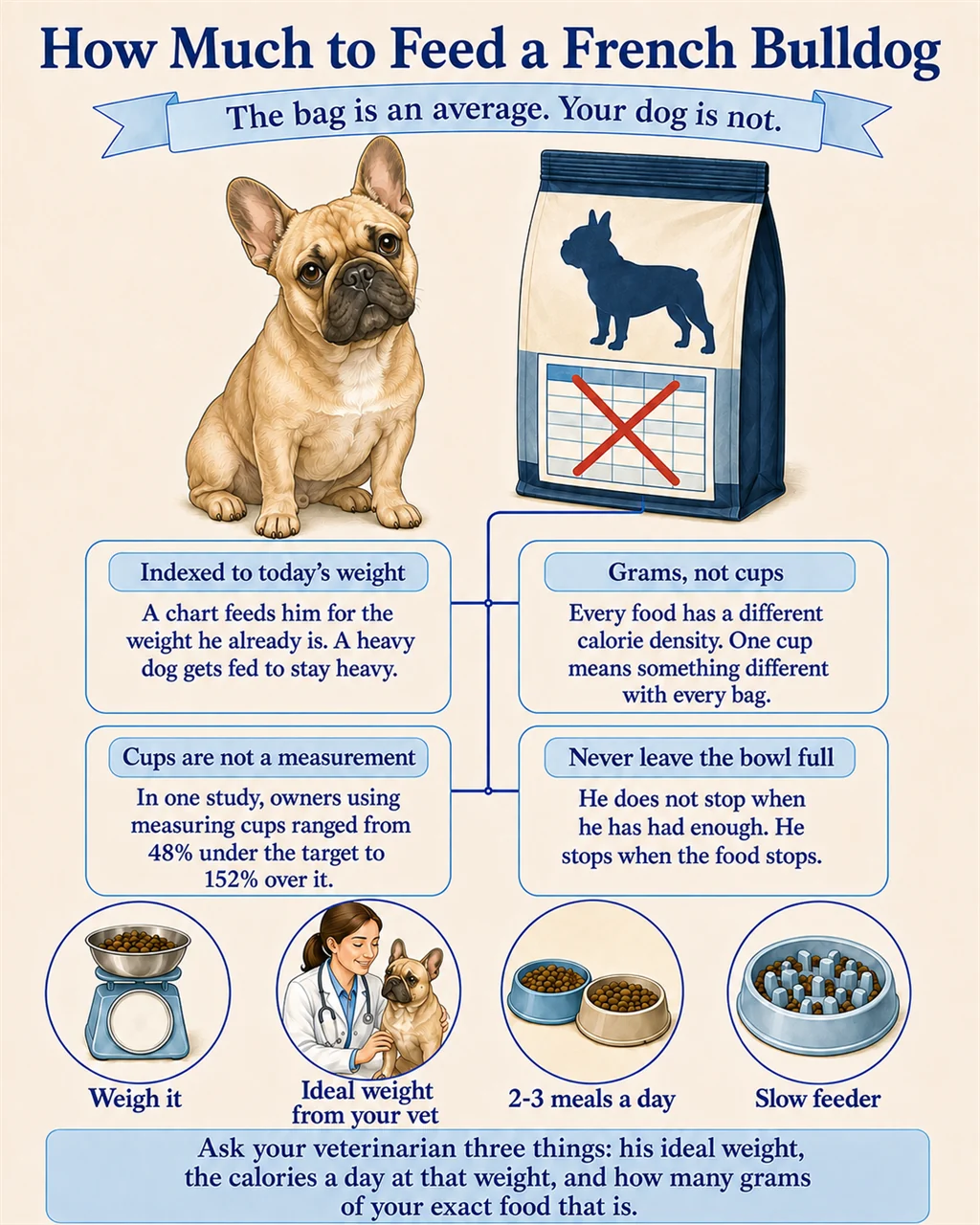
How much should I feed my French Bulldog?
There is no number that fits every Frenchie. Feeding charts are written for an average dog, and they are indexed to your dog’s current weight — so a dog who is already heavy gets fed to stay heavy. The portion is built from his ideal weight, and that number comes from a vet who has measured him, not from a chart. Ask your vet three things: his ideal weight, the calories a day at that weight, and how many grams of your exact food that is. Then weigh the food on a kitchen scale — measuring cups missed by up to half too little and up to two and a half times too much — and split it into two or three meals.
The ten rules
This is the whole method. Read further only where you want to know why.
- The number on the bag is not your dog’s number
- No chart can tell you what he should weigh — not even this one
- Get his ideal weight from a vet who has measured him
- Ask for the portion in grams, not in cups
- Weigh the food on a kitchen scale
- Portion it — never leave the bowl full
- Split the day into two or three meals
- Feed him from a slow-feeder
- Let the vet judge his body condition, not you
- Recalculate whenever something changes
1 The number on the bag is not your dog’s number
The chart on the bag is an average. It has to be — one printed table has to cover every dog of that weight, in every home, at every activity level.
Your Frenchie is not an average. He lives indoors, his walks are short because of the heat and the breathing, and he is very likely neutered. Same weight on the scale, far fewer calories burned in a day.
There is a second problem hiding in the chart: it is indexed to your dog’s current weight. If your Frenchie is already carrying two extra kilos (4.4 lb), the chart cheerfully feeds him for those two extra kilos.
Treat the chart as the manufacturer’s opening offer. The dog standing in front of you settles it.
2 No chart can tell you what he should weigh — not even this one
Spike is 12 kg (26 lb). At 13 kg (29 lb) he is fat. At 10 kg (22 lb) he is thin.
The breed standard for a male French Bulldog says 9 to 14 kg (20 to 31 lb). That official range contains Spike’s fat weight, his thin weight, and everything in between. It was written for judges at dog shows, not for the dog standing on your kitchen scale.
And there are Frenchies half his size. Same breed, same papers, a much smaller frame. Put 12 kg (26 lb) on one of those and he would not be walking — you would be rolling him.
So weight never stands alone. It belongs to a body: a frame, a height, a build. Pairing the two is not something a chart does, and not something you should do by eye.
Not the bag, not the box, not a chart you found online — this page included.
3 Get his ideal weight from a vet who has measured him
It takes a veterinarian who has the dog in front of them — who measures him, looks at him, and then tells you what he should weigh. Then you feed to that number.
Your own clinic first. Most practices have at least one vet who handles weight and nutrition — ask at reception who that is, and book with them. For the large majority of dogs, that is the whole answer.
If it gets complicated — he will not lose weight, he is already obese, he struggles to breathe, he has a condition that changes the math — ask your vet to refer you to, or consult with, a board-certified veterinary nutritionist. There are not many of them and not every country has one, but many consult remotely through your own vet. Ask even if the nearest one is far away.
- What is his ideal weight — not his current weight?
- How many calories a day at that weight?
- How many grams of this exact food is that?
4 Ask for the portion in grams, not in cups
Every food has a different calorie density, so “one cup” means something different every time you change bags. Grams do not move.
Some vets will answer “a cup and a half”, or “one scoop, twice a day”, because that is how the conversation normally goes. Ask for grams anyway.
You are not arguing with your vet. You are asking for the same answer in a unit that cannot drift. A scoop changes with the bag, with the brand, and with how hard the kibble was pressed in. A gram does not.
Write the number down before you leave the room, then write it on the food container with a marker. In six months nobody in the house will remember it, and that is how portions drift.
5 Weigh the food on a kitchen scale
Researchers at the University of Guelph gave each of a hundred dog owners one of three ordinary measuring devices — a pet-store scoop, a kitchen liquid measuring cup or a dry-food measuring cup — and asked them to portion out kibble. The results ran from 48 percent under the target to 152 percent over it. Not a few grams out: two and a half times the intended meal, measured by someone who believed they were measuring.
Two details from that study land straight on this breed. The liquid measuring cup — the baking one, the one already in most kitchens — was the worst of the three. And small portions came out worst of all. A Frenchie eats small portions.
Kibble also settles. The same cup, packed differently, is a different meal. Grams do not care how you shook the container.
Digital kitchen food scale — the flat one that lives next to the food container in our kitchen.
See it on Amazon → Affiliate link — as an Amazon Associate I earn from qualifying purchases.We keep a flat kitchen scale next to the food container. It is the only reason we can tell you what Spike actually eats instead of what we think he eats. Bowl on, zero it, pour to the number. After a week it is faster than scooping — and the argument about whether he has already been fed is over.
6 Portion it — never leave the bowl full
This is the one that quietly undoes everything else on this page. Right food, right number of meals, right vet — and still a heavy dog, because the bowl is never empty.
A French Bulldog does not stop when he has had enough. He stops when the food stops. Hunger behavior in this breed is not information, it is the factory setting.
Leaving food down so he can eat “as much as he wants” is not generosity and it is not freedom. It hands the decision to the one in the house least able to make it.
Weigh the portion. Put it down. Pick the bowl up when he is finished. That is the entire method.
7 Split the day into two or three meals
- Puppies — 3 to 4 meals while young. Feeding by life stage →
- Adults — 2 to 3 meals.
- Reflux-prone dogs — smaller and more often, and nothing in the 2 to 3 hours before bed. Reflux & hiatal hernia →
Why we split it rather than serve one large bowl: one big meal means more air swallowed at once, and more pressure on a stomach that in this breed is already being pulled upward by hard breathing. Splitting the same food into two or three servings costs nothing and removes a trigger.
Our opinion: if your dog has no reflux history, one meal a day is not a catastrophe. For a flat-faced dog we would still split it.
8 Feed him from a slow-feeder
A flat-faced dog does not eat, he inhales. He cannot pick food up cleanly, so he scoops it — and takes air down with it. Air in the stomach is what comes back up later.
A slow-feeder bowl or a snuffle mat makes him work around the obstacles instead of swallowing in one motion. It is one of the few pieces of feeding equipment that is hard to get wrong.
Our opinion: after the kitchen scale, if you buy one more thing for the feeding corner, buy that one.
Raised stainless-steel slow-feeder bowl — Spike uses a version of this one. The ridges make him work around them instead of swallowing in one motion, and stainless steel washes clean properly after every meal. Plastic scratches, and scratches hold onto things.
See it on Amazon → Affiliate link — as an Amazon Associate I earn from qualifying purchases.9 Let the vet judge his body condition, not you
The scale hides a lot, and a Frenchie’s build hides more: broad chest, short back, and no obvious waist to begin with. Vets use a nine-point body condition score. It is a trained assessment — hands on the ribcage, the outline from above, the profile from the side — and every one of those is a judgment built on having done it a thousand times.
Here is what they are feeling for, so you understand the conversation rather than sit through it.
- Ribs — felt easily, under a thin covering.
- From above — a narrowing behind the ribs.
- From the side — a belly that tucks upward.
Read that as a description, not a checklist. You are not grading him. If something feels different to you between visits, that is a reason to book an appointment — never a reason to decide he is fine.
Extra weight in this breed is not a cosmetic issue and not a future one. It narrows an airway that is already narrow, raises the risk of heatstroke, and loads hips and knees that are structurally borderline. The portion is not about looks.
10 Recalculate whenever something changes
- After neutering. Energy needs usually drop; the bowl does not.
- When the food changes. New bag, new calorie density, new number of grams.
- When two people feed the same dog. Write the portion down and put it where the food lives.
- When treats creep in. They belong inside the daily total, not on top of it.
- Never because “he acts hungry”. This breed always acts hungry. Hunger behavior is not a measurement.
Owners Also Ask
How much should I feed my French Bulldog?
There is no number that fits every Frenchie. Feeding charts are written for an average dog, and they are indexed to your dog’s current weight — so a dog who is already heavy gets fed to stay heavy. The portion is built from his ideal weight, and that number comes from a vet who has measured him, not from a chart. Ask your vet three things: his ideal weight, the calories a day at that weight, and how many grams of your exact food that is. Then weigh the food on a kitchen scale — measuring cups missed by up to half too little and up to two and a half times too much — and split it into two or three meals.
Should I weigh my dog’s food or use a measuring cup?
Weigh it. Researchers at the University of Guelph gave each of a hundred dog owners one of three ordinary measuring devices and asked them to portion out kibble; the results ran from 48 percent under the target to 152 percent over it. Small portions were measured worst of all, and a Frenchie eats small portions. A flat kitchen scale removes the problem: bowl on, zero it, pour to the number.
How many meals a day should a French Bulldog eat?
Two or three for an adult, three to four for a young puppy. The reason is the breed, not the calories: one large meal means more air swallowed at once and more pressure on a stomach that is already being pulled upward by hard breathing. Splitting the same food into two or three servings costs nothing and removes a trigger. Our opinion: if your dog has no reflux history, one meal a day is not a catastrophe — but for a flat-faced dog we would still split it.
What is my French Bulldog’s ideal weight?
Only a vet who has measured your dog can tell you. Breed standards give a range of 9 to 14 kg (20 to 31 lb) for a male, but that range contains both the fat weight and the thin weight of the same dog — Spike is 12 kg (26 lb), fat at 13 kg (29 lb) and thin at 10 kg (22 lb). Weight also belongs to a frame: there are Frenchies half his size. Ask your vet for the number, then feed to it.
References
- Coe JB et al. (2019). “Dog owner’s accuracy measuring different volumes of dry dog food using three different measuring devices.” Veterinary Record. vr.105319
- WSAVA Global Nutrition Committee — Global Nutrition Guidelines, including body condition scoring. wsava.org
- AAHA — 2021 Nutrition and Weight Management Guidelines for Dogs and Cats. aaha.org
- University of Guelph — plain-language summary of the measuring-device study. uoguelph.ca
- FCI Standard No. 101 — French Bulldog. Quoted here only to show what a breed standard is not for. fci.be