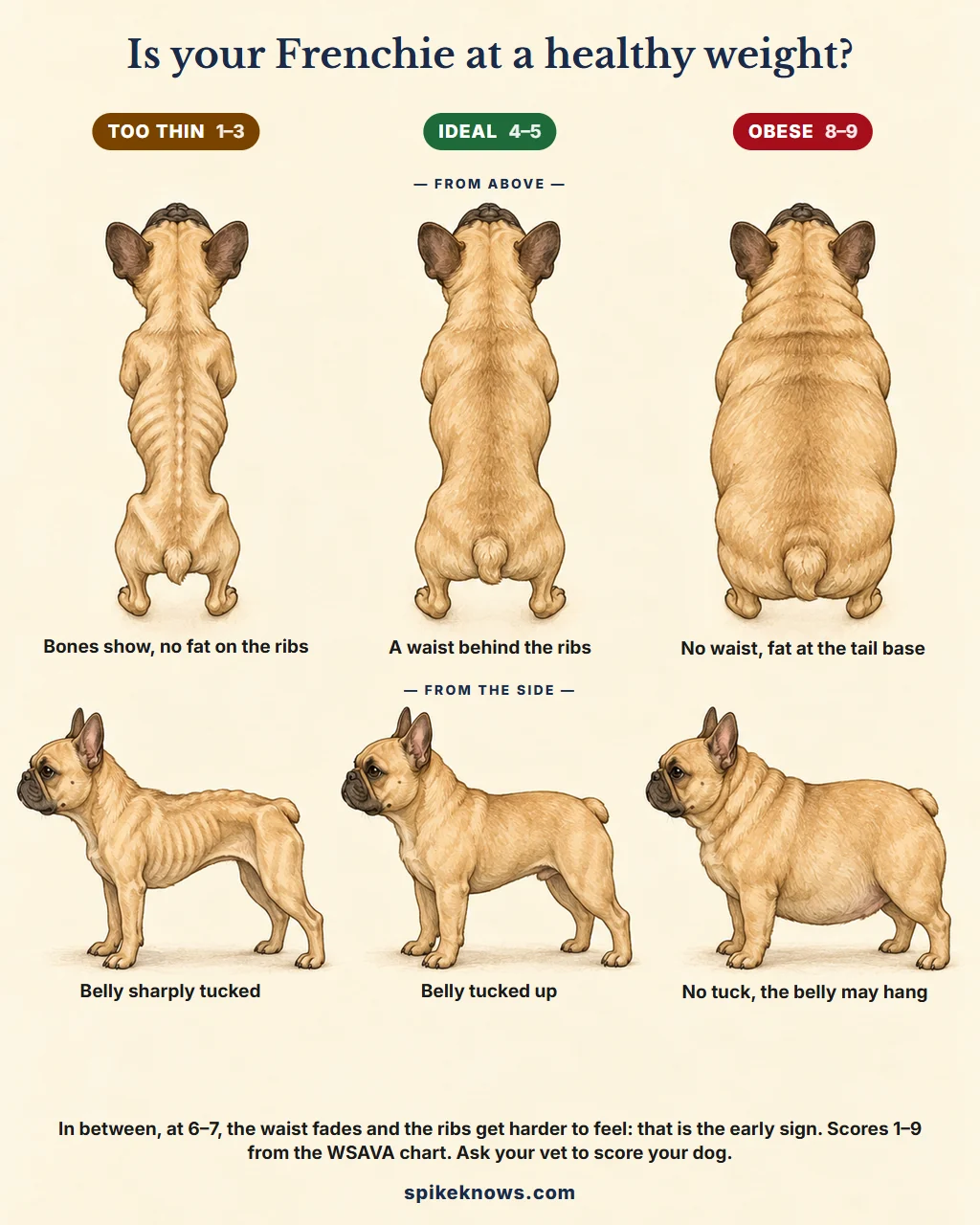
Extra weight on a Frenchie is a health problem, and it lands on a breed that already has more breathing, skin, spine and heat trouble than most dogs. The studies also show the other side: in obese dogs that reached their target weight, owners saw more energy and less pain.
I. Our Rule
Keep your Frenchie at his ideal weight — not skinny, not overweight. Ideal, or a little under it.
Why: each problem in the list below has been linked to extra weight in studies, and the Frenchie starts with higher odds than other dogs for the top four.
What “a little under” means for us: on the 9-point body condition chart that vets use (WSAVA), 4 and 5 are ideal. We aim for the lean end of ideal, 4, where the ribs are easy to feel under a thin layer of fat. That is not a thin dog: at 1 to 3 there is no fat over the ribs, and the spine and hip bones stand out.
Your vet sets your dog’s target weight.
Our experience: two dogs are not a study, so this is only what we saw. On the same day we met an overweight Frenchie with sores on his skin and a lean Frenchie that looked healthy. It fits what the studies below describe for the skin: extra weight can thicken the skin and create new folds, and folds trap friction and moisture.
II. The Risks, Ranked
How we ranked them: 1 to 4 are ordered by how often UK vets diagnosed each problem in Frenchies in one year. Those numbers come from vet records of 2,781 Frenchies (VetCompass, O’Neill 2021) and, for heatstroke, from a study of 905,543 dogs (Hall 2020). 5 to 8 were not measured in Frenchies specifically, so they come after.
1 Breathing (BOAS) — the most common
How common in Frenchies: in one year of UK vet records, 5.5% of Frenchies were diagnosed with BOAS, against 0.2% of other dogs (O’Neill 2021). The authors add that the real number “is grossly underestimated by owners and veterinarians.”
What extra weight does: two studies, and they do not fully agree. Packer 2015 looked at two groups. In the first, 700 dogs of 97 breeds at a referral hospital, body condition score was not linked to BOAS. In the second, 154 flat-faced dogs, it was: each extra point on the 9-point body score almost tripled the odds of BOAS. The authors write that “obesity was found to further increase BOAS risk.” Liu 2017 studied 604 dogs (189 Pugs, 214 French Bulldogs, 201 Bulldogs). This study found the body-score link in Pugs and Bulldogs. In French Bulldogs, it found BOAS linked to the neck: how thick and how long it is compared with the body.
Watch for: noisy breathing, snoring, tiring fast on walks. If you notice them, talk to your vet → BOAS
2 Skin — folds and paws
How common in Frenchies: in the same UK records, 2.2% of Frenchies were diagnosed with skin fold dermatitis in one year (11× the odds of other dogs), and 2.1% with inflamed paws (pododermatitis).
What extra weight does: a large UK study of skin fold dermatitis (O’Neill 2022, 905,553 dogs) did not find a link with a dog’s weight on the scale compared with the average for his breed and sex; a scale shows weight, not fat. What the study does describe: folds can form “subsequent to skin thickening related to obesity,” also on the body and legs of obese dogs, and for treatment it recommends “to address obesity.” The international guidelines on skin infections (ISCAID 2025) list “excess body weight” among the causes of paw inflammation, and say that “facilitating weight loss in overweight dogs may reduce friction and chronic trauma.” For fold infections: “Weight loss or surgical management of skin folds may be helpful in some cases of intertrigo.”
Watch for: red or smelly folds, licking the paws. If you notice them, talk to your vet → Skin folds · Yeast
3 Spine (IVDD)
How common in Frenchies: this number counts all spinal cord disorders, not IVDD alone: 1.1% of Frenchies had one diagnosed in one year, 3× the odds of other dogs (same UK records).
What extra weight does: Packer 2013 measured 700 dogs of 97 breeds at a UK referral hospital; 79 had a disc extrusion (a “slipped disc”) in the back. The study’s example of a high-risk breed is the Miniature Dachshund, not the Frenchie. Result: “both being overweight and skeletally smaller significantly increased IVDE risk,” and “in high-risk breeds … even being moderately overweight increases the risk.”
Watch for: a hunched back, yelping when picked up, wobbly back legs. If you notice any of them, call your vet right away; if he suddenly cannot walk, it is an emergency → IVDD
4 Heatstroke
How common in Frenchies: heat-related illness was diagnosed in 0.18% of Frenchies in one year. That is rarer than the problems above, but heatstroke can kill. Frenchies had 6.49× the odds of Labradors (Hall 2020: 905,543 dogs, 395 heat-related illness events).
What extra weight does: the study measured weight on the scale, not fat. It found “higher bodyweight relative to the breed/sex mean” among the risk factors, and the authors write that “maintaining a healthy bodyweight should be considered key welfare priorities for all dogs to limit the risk of heat-related illness.”
Watch for: heavy panting, a wide tongue, weakness. That is an emergency: cool him first, then the vet → Heatstroke · Emergency: heat
5 Joints — arthritis and the knee ligament
How common in Frenchies: the Frenchies in the UK records were young (half were under about 1.5 years old), and arthritis was rare among them: 0.1% in one year.
What extra weight does: these studies did not measure the effect of weight in Frenchies. Smith 2006 followed 48 Labradors raised in pairs: one dog of each pair got 25% less of the same food than its pair-mate, for life. The pair-mates, the control dogs, could eat as much as they wanted until they were 3 years and 3 months old; then their feeding was adjusted to prevent obesity. The control dogs averaged a body condition score of 6.7 (overweight), the restricted dogs 4.6 (ideal). Hip arthritis first showed on X-rays at a median of 6 years in the control dogs, and at 12 years in the restricted dogs. Taylor-Brown 2015 studied 171,522 dogs of all breeds in England (953 with cruciate ligament disease, a knee ligament). It measured weight on the scale, not fat: “increasing bodyweight within breeds was associated with increased odds of diagnosis.”
Watch for: stiffness, trouble with stairs, bunny-hopping. If you notice them, talk to your vet → Hip dysplasia
6 Anesthesia and surgery
Why it matters for a Frenchie: several problems on this list can end in surgery under anesthesia, BOAS and IVDD among them.
What extra weight does: a small study of 9 obese pet dogs measured oxygen under deep sedation before and after weight loss (Mosing 2013): “obesity decreases oxygenation in dogs during deep sedation. Oxygenation status improves with successful weight loss.” A review of obesity in dogs and cats (German 2006) lists “anesthetic complications” among the problems obese pets may be predisposed to.
7 Energy and pain
Owners of 50 obese dogs of different breeds filled in a quality-of-life questionnaire; 30 of the dogs reached their target weight (German 2012). After the weight loss, the dogs scored higher on vitality and lower on pain and emotional disturbance; anxiety did not change. The authors: “These results indicate demonstrable improvement in HRQOL for obese dogs that successfully lose weight” (HRQOL is health-related quality of life).
8 A shorter life
These studies are on other breeds; no Frenchies were in them. Salt 2019 followed 50,787 middle-aged neutered pet dogs of 12 breeds in North America: “In all breeds, median life span was shorter in overweight compared with normal weight dogs.” The biggest estimated gap was in male Yorkshire Terriers (13.7 vs 16.2 years), the smallest in male German Shepherds (12.1 vs 12.5). In the same 48 Labradors as above (Kealy 2002): “25% restriction in food intake increased median life span and delayed the onset of signs of chronic disease.”
III. How to Check Him
Vets do not judge weight by the scale alone. They use a body condition score: a chart from 1 to 9 (WSAVA, the World Small Animal Veterinary Association), where 4 and 5 are ideal. Three checks, with your hands and your eyes:
- Ribs: run your flat hands along his sides. At ideal, the ribs are easy to feel under a thin layer of fat.
- From above: look down at him while he stands. At ideal, you see a waist behind the ribs.
- From the side: at ideal, the belly is tucked up behind the chest.
| Score | What you feel and see (WSAVA chart, in our words) |
|---|---|
| 1–3 · Too thin | No fat to feel over the ribs; the top of the spine and the hip bones show (at 1–2, the bones are easy to see) |
| 4 · Ideal | Ribs easy to feel under a thin layer of fat; waist easy to see from above; belly tucked up |
| 5 · Ideal | Ribs can be felt with no extra fat; waist behind the ribs from above; belly tucked up from the side |
| 6 · Above ideal | Ribs under a slight extra layer of fat; waist visible from above, but not clearly |
| 7 · Overweight | Ribs hard to feel; fat over the lower back and at the base of the tail; waist gone or barely visible |
| 8–9 · Obese | Ribs cannot be felt, or only with firm pressure; no waist and no tuck; the belly may hang. At 9: the belly clearly hangs, with fat on the neck and legs |
The early sign: ribs that are getting harder to feel, a waist that is fading, fat gathering at the base of the tail. If you notice any of these, talk to your vet.
Do the three checks once a month, and ask your vet to show you, on your own dog, what his ideal feels like.
IV. Are Frenchies Prone to It?
Not more than other dogs, in the one study we found that compares them. In one year of UK vet records, obesity was recorded in 1.3% of Frenchies and in 7.2% of other dogs, about 0.3× the odds (O’Neill 2021, 2,781 Frenchies). A second UK study (Pegram 2021: 22,333 dogs, 7.1% of them recorded as overweight) writes that vets are likely “underreporting overweight status,” so the real numbers are probably higher for all dogs.
So the danger is not how often a Frenchie gets fat. It is what extra weight does to a breed that already starts with high odds of BOAS, skin fold disease, spine problems and heatstroke.
V. What We Did Not Find
We leave these out of the list above, and here is why:
- Kneecap (patellar luxation): Frenchies have it more often than other dogs (2.0% in one year, 2.31× the odds; O’Neill 2021). But in the large UK study on kneecaps (O’Neill 2016, 210,824 dogs), dogs lighter than the average for their breed and sex were diagnosed more often (1.4× the odds). See Kneecap dislocation.
- Reflux and hiatal hernia: in 11 Frenchies with a sliding hiatal hernia (Ullal 2024), the study found no significant link between body condition score and the share of time the esophagus was exposed to acid. We found no study that links weight to hiatal hernia in Frenchies. See Reflux & hiatal hernia.
- Diabetes: the sources disagree. A 2006 review lists diabetes among the problems obese dogs and cats may be predisposed to (German 2006). A 2014 review of the evidence in dogs says that obese dogs become resistant to insulin, but “there is no evidence that dogs develop type 2 diabetes” (Verkest 2014).
- Life span of overweight Frenchies: no study we found measured it. The life-span studies above are on other breeds.
VI. What Helps
- A body score at every vet visit. The AAHA guidelines say a nutritional assessment, including a body condition score, “should ideally be performed at every examination.” Ask for it.
- A plan from your vet if he needs to lose weight: which food, how much, how fast. The same guidelines: “Individualized nutritional recommendations … should be designed to achieve and maintain an appropriate body weight.”
- Food first, exercise second. “Dietary therapy forms the cornerstone of weight management in dogs and cats, but increasing exercise and behavioral management form useful adjuncts” (German 2006).
- Measure the food. Ask your vet how many grams, and weigh it → How much to feed.
For a Frenchie, more exercise means short walks in the cool hours, never in the heat (see Heatstroke). And treats are food too: they count.
References
- O’Neill DG et al. French Bulldogs differ to other dogs in the UK in propensity for many common disorders: a VetCompass study. Canine Med Genet, 2021. PMC8675495
- Packer RMA et al. Impact of Facial Conformation on Canine Health: Brachycephalic Obstructive Airway Syndrome. PLoS One, 2015. PMC4624979
- Liu NC et al. Conformational risk factors of brachycephalic obstructive airway syndrome (BOAS) in pugs, French bulldogs, and bulldogs. PLoS One, 2017. PMC5538678
- O’Neill DG et al. Ironing out the wrinkles and folds in the epidemiology of skin fold dermatitis in dog breeds in the UK. Sci Rep, 2022. PMC9259571
- Loeffler A et al. Antimicrobial use guidelines for canine pyoderma by the International Society for Companion Animal Infectious Diseases (ISCAID). Vet Dermatol, 2025. PMC12058580
- Packer RMA et al. How long and low can you go? Effect of conformation on the risk of thoracolumbar intervertebral disc extrusion in domestic dogs. PLoS One, 2013. PMC3722130
- Hall EJ, Carter AJ, O’Neill DG. Incidence and risk factors for heat-related illness (heatstroke) in UK dogs under primary veterinary care in 2016. Sci Rep, 2020. PMC7303136
- Smith GK et al. Lifelong diet restriction and radiographic evidence of osteoarthritis of the hip joint in dogs. JAVMA, 2006. doi.org
- Taylor-Brown FE et al. Epidemiology of Cranial Cruciate Ligament Disease Diagnosis in Dogs Attending Primary-Care Veterinary Practices in England. Vet Surg, 2015. doi.org
- Mosing M et al. Oxygenation and ventilation characteristics in obese sedated dogs before and after weight loss: a clinical trial. Vet J, 2013. doi.org
- German AJ et al. Quality of life is reduced in obese dogs but improves after successful weight loss. Vet J, 2012. doi.org
- Salt C et al. Association between life span and body condition in neutered client-owned dogs. J Vet Intern Med, 2019. PMC6335446
- Kealy RD et al. Effects of diet restriction on life span and age-related changes in dogs. JAVMA, 2002. doi.org
- WSAVA Global Nutrition Committee. Body Condition Score (dog). wsava.org
- Cline MG et al. 2021 AAHA Nutrition and Weight Management Guidelines for Dogs and Cats. JAAHA, 2021. doi.org
- German AJ. The growing problem of obesity in dogs and cats. J Nutr, 2006. doi.org
- Pegram C et al. Frequency, breed predisposition and demographic risk factors for overweight status in dogs in the UK. J Small Anim Pract, 2021. doi.org
- O’Neill DG et al. The epidemiology of patellar luxation in dogs attending primary-care veterinary practices in England. Canine Genet Epidemiol, 2016. PMC4898461
- Ullal TV et al. Evaluating acidic gastroesophageal reflux with wireless pH monitoring in French bulldogs with sliding hiatal herniation. J Vet Intern Med, 2024. PMC11099765
- Verkest KR. Is the metabolic syndrome a useful clinical concept in dogs? A review of the evidence. Vet J, 2014. doi.org